 Comparison
Is Dry Needling Worth It for Shoulder Pain?
Last Updated: October 24, 2026
Quick Summary
Is dry needling worth it for shoulder pain depends on your specific diagnosis and goals. It excels at providing short-term relief by releasing trigger points, typically lasting up to one week, making it most valuable when combined with exercise-based physical therapy rather than used alone.
- Dry needling typically provides pain relief lasting up to one week for myofascial shoulder pain.
- Research shows dry needling significantly improved shoulder function and pain for rotator cuff problems in short-term studies.
- Long-term effectiveness is less established; benefits are most durable when combined with consistent exercise and movement strategies.
- Common side effects are minor and self-limiting, including soreness for 24-48 hours; serious complications are rare with trained practitioners.
- Dry needling works best as a complement to exercise-based physical therapy, not as a standalone solution for structural problems.
Table of Contents
- What Dry Needling Is and How It Works for Shoulder Pain
- Dry Needling for Rotator Cuff Pain: What the Evidence Shows
- Short-Term Pain Relief vs. Long-Term Results
- How Long Does Dry Needling Relief Last?
- Dry Needling Side Effects and Safety Concerns
- Dry Needling vs. Exercise for Shoulder Pain
- Is Dry Needling Right for Your Shoulder Pain? A Decision Framework
- Getting Started With a Shoulder Pain Evaluation
- Frequently Asked Questions
What Dry Needling Is and How It Works for Shoulder Pain
Dry needling is a technique where a physical therapist inserts a thin needle directly into muscle tissue to reduce pain and improve function, and whether is dry needling worth it for shoulder pain depends on your specific diagnosis and goals.
For shoulder pain specifically, dry needling addresses the rotator cuff muscles and surrounding tissues that often become restricted after injury, overuse, or prolonged tension. The goal is to release muscle tension and restore normal movement patterns. According to research on dry needling for shoulder pain, patients with chronic shoulder pain associated with myofascial pain syndrome reported significant improvement in pain intensity and pain interference.
The procedure itself takes 10-15 minutes per session. The physical therapist locates the trigger point, inserts the needle, and may move it gently to elicit a "local twitch response", a brief involuntary muscle contraction that signals the needle has reached the target. Most patients tolerate the procedure well, though sensation varies from person to person.
Dry Needling for Rotator Cuff Pain: What the Evidence Shows
The rotator cuff is particularly vulnerable to trigger points because these four small muscles stabilize the shoulder joint and are heavily involved in overhead movements. When trigger points develop in rotator cuff muscles, they can limit your range of motion and create pain with everyday activities like reaching, lifting, or sleeping on that side.
Research on dry needling for rotator cuff problems shows mixed but encouraging results. A recent study found that deep dry needling of rotator cuff trigger points significantly improved shoulder function, stability, pain, and disability. This suggests the technique can address multiple aspects of rotator cuff dysfunction at once, not just pain relief.
However, it's important to understand what "significantly improved" means in context. The research shows measurable gains in function and pain reduction, but the durability of those improvements varies. Some patients experience lasting relief; others see symptoms return within weeks.
Short-Term Pain Relief vs. Long-Term Results
Here's where the evidence becomes more nuanced. A systematic review and meta-analysis found that dry needling was superior to sham or no intervention and similarly effective to other interventions for short-term pain reduction. The key word is short-term. Most studies showing benefit measure outcomes within 2-4 weeks after treatment.
Long-term effectiveness is less clear. A 2017 review noted that evidence supporting long-term reductions in pain or functional improvements was lacking. This doesn't mean dry needling doesn't work, it means the research hasn't yet established how durable the benefits are beyond the immediate post-treatment period.
The distinction matters for your decision. If you're looking for quick relief to get through a flare-up or to reduce pain enough to start physical therapy exercises, dry needling may deliver. If you're hoping for a permanent solution without ongoing self-management, the evidence doesn't support that expectation.
How Long Does Dry Needling Relief Last?
According to the research, the analgesic effect from dry needling typically lasts up to one week for patients with myofascial shoulder pain. This timeframe aligns with what most practitioners observe clinically, patients often report peak relief in the first 3-5 days after treatment, with gradual diminishment over the following days.
This duration is both a strength and a limitation. For someone in acute pain, a week of relief can be transformative, it may allow you to sleep better, move more freely, and begin rehabilitation exercises. But it also means dry needling isn't a one-time fix. Most treatment plans involve multiple sessions spaced 1-2 weeks apart, depending on your response and the severity of your condition.
The length of relief can vary based on several factors: how chronic your condition is, whether you're doing exercises between sessions, your overall muscle tension patterns, and your individual healing response. Some people experience longer-lasting relief with each successive treatment; others plateau after a few sessions.
Dry Needling Side Effects and Safety Concerns
Dry needling is generally safe when performed by a licensed physical therapist with specific training, but it's not risk-free.
Common side effects are minor and self-limiting. Most people experience soreness at the needle site for 24-48 hours, similar to muscle soreness after a workout. Bruising or a small drop of blood can occur.
Rare but serious complications include pneumothorax (collapsed lung) if a needle is inserted too deeply near the chest wall. This is extremely uncommon when a trained practitioner uses proper technique and avoids high-risk areas.
Contraindications mean you should avoid dry needling or get medical clearance first. Absolute contraindications include active infection, severe bleeding disorders, and needle anxiety that prevents you from tolerating the procedure.
Screening is essential. A qualified practitioner will review your medical history, medications, and any conditions that affect bleeding or healing. They will also assess your shoulder to rule out structural issues that need different treatment.
Grab a Free Discovery Call Today →
When performed appropriately, the risk-benefit profile of dry needling is favorable for many people with muscle-based shoulder pain. The key is proper screening, a skilled practitioner, and realistic expectations about the temporary nature of relief.
Dry Needling vs. Exercise for Shoulder Pain
When deciding whether dry needling is worth it for your shoulder, it helps to see how it stacks up against the other main options.
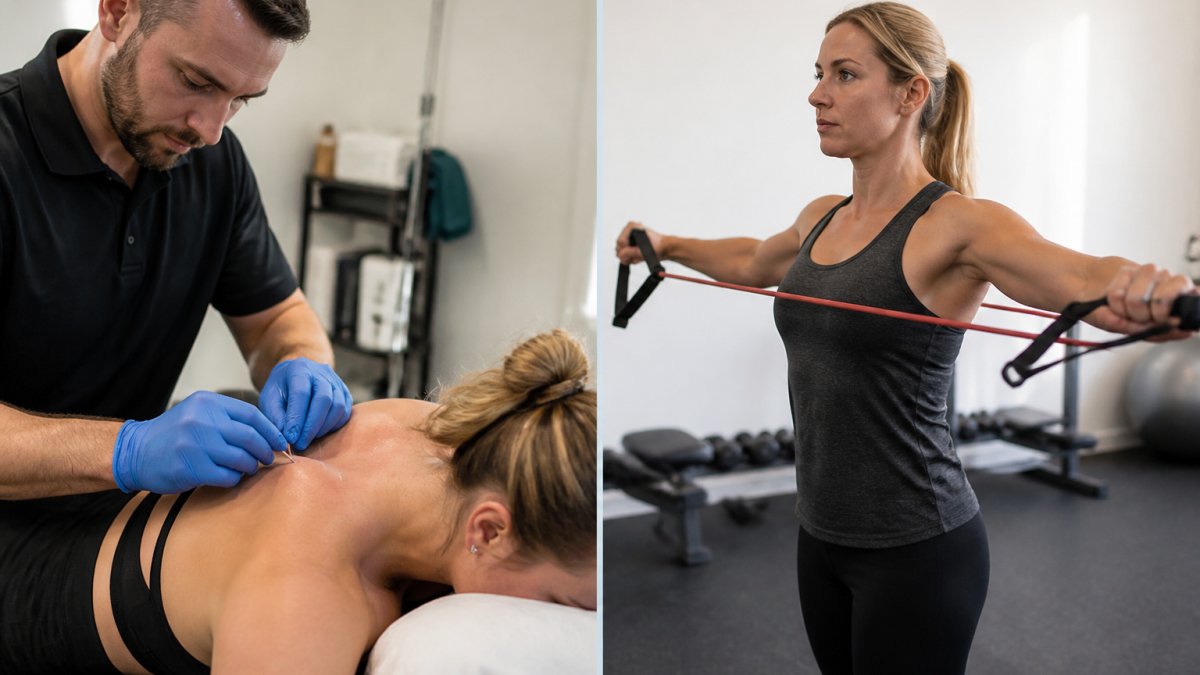
Exercise-based physical therapy focuses on strengthening the rotator cuff and scapular stabilizers, improving mobility, and correcting movement patterns. It has strong evidence for both short-term pain relief and long-term functional improvement.
Manual therapy (hands-on joint mobilization and soft-tissue work) can reduce pain and improve mobility in the short term, especially when combined with exercise. It's often used to prepare the shoulder for strengthening.
Acupuncture follows traditional Chinese medicine principles and targets different points than dry needling.
Injections (corticosteroids or viscosupplementation) are typically reserved for more severe or persistent cases.
So where does dry needling fit? Dry needling excels at quickly reducing muscle tension and trigger points that limit movement.
| Option | Best for | Typical course | Key limitation |
|---|---|---|---|
| Exercise-based PT | Most shoulder pain, especially chronic or movement-related | 6-12 weeks, 1-2 sessions/week plus home program | Requires consistent effort; results take time |
| Manual therapy | Short-term pain relief and mobility gains, often combined with exercise | 2-6 sessions | Temporary effects; best as adjunct |
| Dry needling | Releasing trigger points to enable exercise; short-term relief | 3-6 sessions spaced 1-2 weeks apart | Effects typically last days to a week; not for structural problems |
| Acupuncture | Pain relief for some individuals; alternative approach | Varies; often 6-12 sessions | Evidence mixed; different paradigm |
| Injections | Severe pain or inflammation; bridge to rehab | 1-3 injections | Doesn't fix movement dysfunction; repeated use has risks |
At Spinal Haven, we use the Selective Functional Movement Assessment (SFMA) to identify the root cause of your shoulder pain, whether it's a movement pattern issue, muscle weakness, or restricted mobility.
Is Dry Needling Right for Your Shoulder Pain? A Decision Framework
Use this framework to evaluate whether dry needling fits your situation:
| Your Situation | Dry Needling May Help | Consider Alternatives First |
|---|---|---|
| Acute muscle tension limiting movement | Yes, as a complement to exercise | If pain is mild, exercise alone may suffice |
| Chronic shoulder pain with tight trigger points | Yes, for short-term relief | Long-term: focus on exercise and movement patterns |
| Rotator cuff injury or tear | No, unless combined with rehabilitation | Physical therapy with targeted strengthening is essential |
| Pain with overhead activities | Yes, if caused by muscle tension | If structural (labral tear, impingement), needling won't fix it |
| Willing to commit to exercise between sessions | Yes, increases durability of results | Needling alone without exercise has limited benefit |
| Prefer to avoid needles or have needle anxiety | No | Exercise, manual therapy, or other modalities are better options |
Ask yourself these questions: Is your shoulder pain primarily from muscle tightness, or does it feel structural (sharp, catching, unstable)? Are you willing to do exercises consistently between treatments? Do you need relief quickly to return to activity, or are you looking for a permanent solution?
If your pain stems from movement dysfunction or weakness, exercise-based physical therapy should be your priority. If tight muscles are preventing you from exercising, dry needling can be a useful first step. Explore the full range of one-on-one spinal physical therapy services as an alternative or complement to dry needling.
Getting Started With a Shoulder Pain Evaluation
The first step is a proper assessment. A qualified physical therapist will evaluate your shoulder through movement testing, range-of-motion assessment, and palpation to identify the actual source of your pain. This matters because shoulder pain can originate from the rotator cuff, the joint capsule, the neck, or even referred pain from your mid-back.
Once the root cause is identified, your therapist can recommend whether dry needling is appropriate for your case. If it is, they'll explain what to expect, how many sessions might be needed, and what you'll do between sessions to maximize results.
Schedule a 15-minute discovery call with Dr. Elizabeth Kingshott Cary to see whether dry needling or other treatments are appropriate for your shoulder pain. During this conversation, you can discuss your symptoms, your goals, and what approach makes sense for your situation. Find answers to common questions about evaluations and what to expect before booking.
The bottom line: is dry needling worth it for shoulder pain if you have muscle-based shoulder pain, need short-term relief to enable exercise, and are willing to combine it with movement-based therapy.
Frequently Asked Questions
Will dry needling help with shoulder pain?
Dry needling may provide short-term pain relief for certain types of shoulder pain, particularly myofascial pain syndrome. Research from 2021 found that dry needling was associated with significant improvement in pain intensity and pain interference, with analgesic effects lasting up to one week. However, a 2023 systematic review concluded that dry needling was effective for short-term pain reduction but noted that evidence for long-term pain reduction or functional improvement was lacking. Whether it will help depends on your specific condition and should be evaluated by a qualified physical therapist.
How long does relief from dry needling last?
According to research, the analgesic effect from dry needling for shoulder pain typically lasts up to one week. A 2021 study on chronic shoulder pain associated with myofascial pain syndrome reported that patients experienced significant pain relief, but the duration was limited to approximately seven days. A 2017 review noted that evidence supporting long-term pain reduction or functional improvement from dry needling was lacking, suggesting that repeated sessions may be needed to maintain relief.
Is dry needling safe for shoulder pain?
Dry needling is generally considered a low-risk procedure when performed by a qualified practitioner, but it does carry some potential side effects. Common reactions include temporary soreness, bruising, or minor bleeding at the needle site. More serious complications are rare but can include infection or nerve damage if the procedure is not performed correctly. Before undergoing dry needling, discuss your medical history and any concerns with your healthcare provider to determine whether it is appropriate for your specific shoulder condition.
Is exercise more effective than dry needling for shoulder pain?
A 2023 systematic review found that dry needling was similarly effective to other interventions for short-term pain reduction, but it did not establish superiority over exercise-based approaches. Many physical therapists recommend combining movement and exercise with other treatments rather than relying on dry needling alone. Exercise addresses the root causes of shoulder dysfunction and builds long-term strength and stability, whereas dry needling provides temporary symptom relief. For lasting improvement, an integrated approach that includes therapeutic exercise is typically more effective than needling in isolation.