 how-to
Deadlifts With Mild Disc Herniation: A Safe Return Guide
Table of Contents
- Can You Deadlift With a Mild Disc Herniation?
- Understanding Disc Herniation and Lifting Risk
- Weightlifting With a Herniated Disc: What You Need to Know
- Exercises to Avoid With a Herniated Disc
- Deadlift Modifications for Back Pain
- How to Return to Deadlifting After Back Injury
- Red Flags and When to Stop Lifting
- The Role of Physical Therapy in Your Recovery
- Frequently Asked Questions
Last Updated: October 12, 2026
Can You Deadlift With a Mild Disc Herniation?
Yes, you can perform deadlifts with disc herniation in many cases, but it requires careful planning and professional guidance.
At Spinal Haven, we work with active adults who want to return to strength training after disc-related back pain.
This guide walks you through exactly how to assess your readiness, modify your deadlift technique, and progress safely back to full strength.
Understanding Disc Herniation and Lifting Risk
A disc herniation happens when the soft material inside a spinal disc pushes through a tear in the outer layer. This can irritate nearby nerves and cause pain, numbness, or weakness. The question isn't whether deadlifting is impossible, it's whether your specific situation allows it right now.
How disc herniation affects spinal loading
When you deadlift, your lower back experiences significant compressive force. A herniated disc in your lumbar spine becomes more sensitive to certain movements, especially heavy flexion (bending forward) combined with load.
The risk isn't the same for everyone. A mild herniation that doesn't touch a nerve behaves very differently from one causing radiating pain down your leg. Your symptoms matter more than the imaging findings alone.
Common patterns we see:
- Pain that worsens with heavy loads or high repetitions
- Stiffness that improves with light movement
- Symptoms that settle within a few minutes of stopping exercise
- Radiating pain or numbness (a red flag requiring medical evaluation first)
When medical evaluation is necessary
Before you attempt any deadlifting, you need professional assessment. This isn't optional.
See a physician or physical therapist if:
- You haven't had imaging (MRI or CT scan) confirming disc herniation
- You experience radiating pain, numbness, or weakness in your legs
- You have difficulty with bowel or bladder control
- Your pain is severe or getting worse despite rest
- You've never had a professional movement assessment
A qualified physical therapist can identify which movements aggravate your disc and which ones you tolerate well. This information is essential before you load any movement.
Weightlifting With a Herniated Disc: What You Need to Know
Not all weightlifting is equal when you have a herniated disc. Some exercises load your spine in ways that compress the injury.
The conventional deadlift places your spine in a vulnerable position if you're not ready: it combines forward bending, heavy compression, and shear forces.
Your goal is to find the threshold where you can train without triggering symptoms. That threshold changes week to week as you recover.
Exercises to Avoid With a Herniated Disc
Certain movements create too much spinal stress when you're recovering from disc herniation. Avoiding them early prevents setbacks that can set your recovery back weeks.
Skip these until cleared by your physical therapist:
- Heavy conventional deadlifts (full range, heavy load)
- Barbell rows with heavy weight
- Sit-ups or crunches with resistance
- Heavy leg press with excessive forward knee travel
- Loaded spinal twists or rotations
- Good mornings with load
The reason: these movements either compress an irritated disc or pull it further out of position.
Low-impact alternatives exist for nearly every movement you want to do. The trick is finding them before you need them.
Deadlift Modifications for Back Pain
You don't have to abandon the deadlift. You modify it, sometimes significantly, until your disc tolerates more load.
Maintaining neutral spine position
A neutral spine is the position where your vertebrae stack safely and your discs experience the least pressure. It's not perfectly straight, it has natural curves.
For deadlifting, neutral means:
- Your lower back maintains its natural curve (not flattened, not hyperextended)
- Your chest stays upright relative to your hips
- Your shoulders sit directly over the bar at the start
- Your head stays in line with your spine (not jutting forward)
Losing neutral spine is the single biggest mistake we see. People either round their lower back (flexion) or hyperextend it (extension), both of which stress a herniated disc.
To find your neutral:
- Stand with feet hip-width apart
- Place your hands on your lower back ribs
- Tilt your pelvis forward and back slowly
- Stop at the midpoint, that's neutral
- Practice this position without weight first
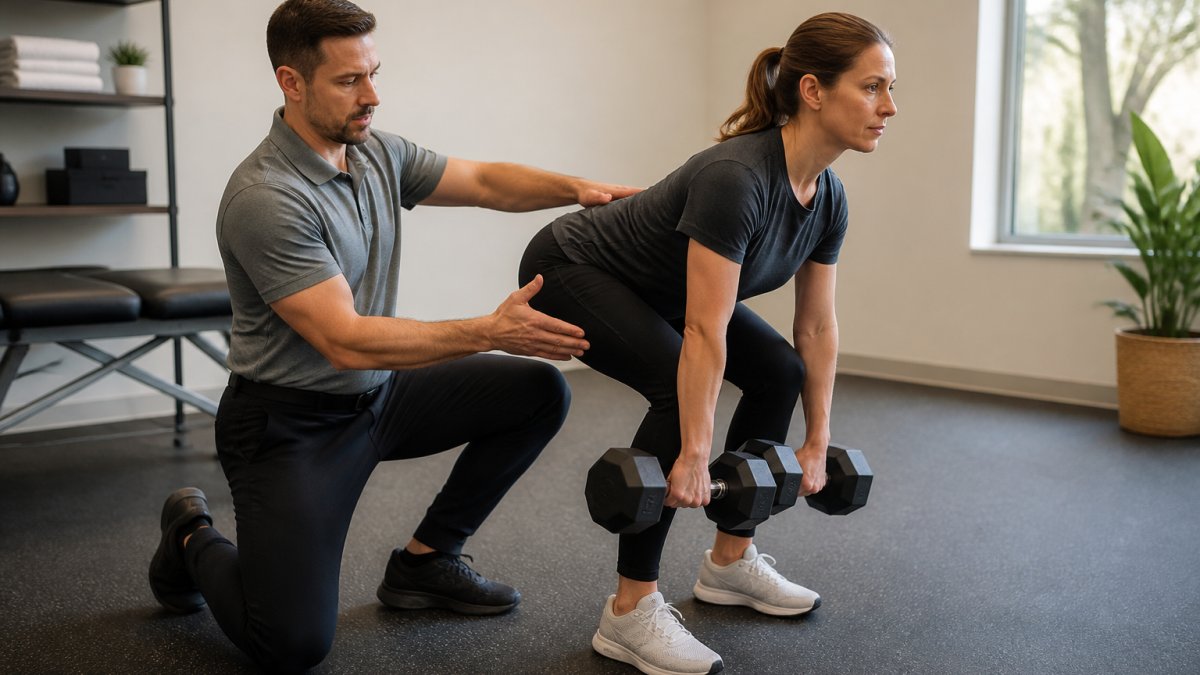
Once you own neutral, practice holding it while you hinge at the hips. Hip hinge is the foundation of a safe deadlift modification.
Reducing load and progressing gradually
Start light. Much lighter than you think you need.
If you haven't deadlifted in months, your nervous system needs retraining. Your disc needs to adapt to load gradually. Your confidence needs rebuilding.
A practical progression:
- Week 1-2: Bodyweight hip hinge, 3 sets of 5 reps, 2x per week
- Week 3-4: Light dumbbell deadlift (5-10 lbs each hand), 3 sets of 5, 2x per week
- Week 5-6: Increase to 10-15 lbs, add a third weekly session if pain-free
- Week 7-8: Barbell deadlift with empty bar, 3 sets of 5, 2-3x per week
- Week 9+: Add weight in small increments (5-10 lbs per week)
This feels slow. It is. It's also the difference between returning to deadlifting and reinjuring yourself and starting over.
Pain-free doesn't mean you're ready to jump ahead. You're building tolerance, not testing your limit.
Monitoring pain response during and after lifting
How your back feels during and after training tells you whether you're progressing safely or pushing too hard.
During the set:
- Mild discomfort is acceptable
- Sharp pain is a stop signal
- Radiating pain means stop immediately
- Numbness or tingling means stop
After the session (next few hours):
Grab a Free Discovery Call Today →
- Mild soreness is normal
- Increased pain or stiffness is a warning
- Pain that lasts more than a few hours suggests you did too much
After 24 hours:
- You should feel better or the same, not worse
- If you're stiffer or more painful the next day, you overloaded
Keep a simple log: date, exercise, weight, reps, how you felt during, how you felt after. This data shows patterns.
How to Return to Deadlifting After Back Injury
Returning to deadlifting isn't linear. You'll have good days and tough days. The goal is steady progress, not perfection.
Phase 1: Pain-free range of motion work
Before you add load, restore pain-free movement.
This phase is about retraining your nervous system. Your body learned to protect the injured area by limiting movement. You're teaching it that movement is safe again.
What to do:
- Cat-cow stretches: 2 sets of 10, daily
- Child's pose: hold 30 seconds, 3 reps, daily
- Quadruped rocking: 2 sets of 10, 3-4x per week
- Bird dogs: 2 sets of 8 each side, 3-4x per week
- Glute bridges: 2 sets of 10, 3-4x per week
Duration: Stay in this phase 2-4 weeks. Don't rush it. You need several weeks of pain-free movement before adding load.
Success marker: You can move through your full range of motion without pain or stiffness.
Phase 2: Light load and controlled progression
Now you add weight, starting very light.
The conventional deadlift isn't the first choice here. Trap bar deadlifts, dumbbell deadlifts, or kettlebell deadlifts are often better early options. They reduce spinal stress compared to conventional form.
Week 1-2:
- Trap bar deadlift or dumbbell deadlift
- 3 sets of 5 reps
- Light weight (focus on form, not load)
- 2 sessions per week
- 2-3 days rest between sessions
Week 3-4:
- Same movement
- 3 sets of 5-8 reps
- Slightly increase weight if pain-free
- Can add a third session if recovery is good
Week 5-6:
- Same movement
- 3 sets of 8 reps
- Gradual weight increase
- 2-3 sessions per week
Success marker: You complete all reps with perfect form, no pain during or after, and feel stronger than the previous week.
Phase 3: Building strength and lifting capacity
Once you've proven you can handle light load pain-free, you progress to conventional deadlift if desired.
This phase typically starts 6-8 weeks into your return. You're rebuilding strength and confidence.
Progression approach:
- Increase weight by 5-10 lbs per week if pain-free
- Maintain 3-5 reps per set for strength building
- Keep 2-3 sessions per week
- Continue monitoring pain response
You're not chasing your old maxes. You're building a sustainable deadlift that your disc tolerates long-term.
| Phase | Duration | Load | Frequency | Key Focus |
|---|---|---|---|---|
| Phase 1 | 2-4 weeks | Bodyweight only | Daily or 4-5x/week | Pain-free movement |
| Phase 2 | 4-6 weeks | Light (5-20 lbs) | 2-3x/week | Form and tolerance |
| Phase 3 | 6+ weeks | Progressive load | 2-3x/week | Strength and capacity |
Red Flags and When to Stop Lifting
Some symptoms mean you should stop immediately and seek professional guidance.
Stop training and contact a healthcare provider if you experience:
- Sharp, stabbing pain during or after lifting
- Radiating pain down your leg (sciatica)
- Numbness or tingling in your legs or feet
- Weakness that worsens over days
- Loss of bowel or bladder control
- Pain that doesn't settle within a few hours of stopping exercise
These aren't signs of weakness. They're signals that something needs professional attention before you continue.
Pain that's mild and settles quickly is different. Mild discomfort during early return-to-training is normal. The distinction matters.
A useful rule: if you're unsure whether to stop, stop. You can always resume training once you've confirmed it's safe.
The Role of Physical Therapy in Your Recovery
Physical therapy isn't just for acute injury. It's essential for building a sustainable return to deadlifting.
A qualified physical therapist does several things:
- Identifies your specific restrictions: Which movements aggravate your disc? Which ones feel safe? This varies person to person.
- Assesses your movement patterns: Poor hip mobility, weak glutes, or asymmetrical strength often contribute to disc injury. Fixing these prevents reinjury.
- Teaches you self-management: The goal is independence, not endless appointments. You learn which movements you can do safely and how to progress on your own.
- Monitors your progress: Regular check-ins catch problems early. If you're progressing too fast, a therapist adjusts your plan before you get hurt again.
At Spinal Haven, we use movement-based assessment to understand how your specific body responds to loading.
The investment in proper guidance early prevents months of setbacks later.
Returning to deadlifts with disc herniation is possible. It requires patience, proper technique, and professional guidance to do safely.
Frequently Asked Questions
Can you deadlift with a mild disc herniation?
Yes, many people with mild disc herniation can return to deadlifting with proper modifications, professional guidance, and a gradual progression plan. The key is working with a physical therapist to assess your specific condition, modify your technique to protect your spine, and progress load carefully. Your ability to deadlift depends on your individual symptoms, the location and severity of your herniation, and how your body responds to controlled loading. Starting with pain-free range of motion and light weights, then progressing gradually as tolerated, allows many active adults to safely return to deadlifting.
What exercises should I avoid with a herniated disc?
Avoid exercises that combine spinal flexion (forward bending) with heavy loading, such as conventional sit-ups, leg press with excessive forward trunk lean, or rounded-back rows. High-impact activities like jumping or running may also aggravate symptoms early in recovery. Avoid loaded spinal rotation and extreme ranges of motion until you've progressed significantly. Instead, focus on exercises that maintain neutral spine position, such as planks, bird-dogs, and controlled hip-hinge movements. Your physical therapist can identify which specific movements provoke your symptoms and help you find safe alternatives.
How do I know if I'm ready to return to deadlifting?
You're ready when you can perform pain-free hip hinge movements, maintain neutral spine position during light loads, and have completed a progressive strengthening program with your physical therapist. Specific readiness markers include: pain-free single-leg stance, ability to hold a plank without compensation, and successful tolerance of light resistance exercises over several weeks. Your therapist will assess your movement quality, core stability, and symptom response before clearing you to progress. Never rush this timeline; a gradual return reduces reinjury risk and builds confidence in your body's capacity.
What should I do if I experience pain while deadlifting?
Stop immediately and avoid that movement or load level for at least 48 hours. Sharp, radiating, or escalating pain is a red flag requiring professional evaluation. Mild muscle soreness is normal, but nerve-related symptoms (tingling, numbness, shooting pain down the leg) warrant urgent medical attention. Track when pain occurs, what movement triggered it, and how long it lasts. Report this pattern to your physical therapist or physician at your next appointment. Pain is your body's signal that you've exceeded your current capacity; respecting that signal prevents setback and keeps you on track for long-term recovery.