 how-to
McKenzie Method for Neck Pain: A Step-by-Step Guide
Table of Contents
- What the McKenzie Method Is and How It Treats Neck Pain
- McKenzie Method Assessment for Neck Pain: How Classification Works
- McKenzie Neck Exercises: Step-by-Step Instructions
- How Long to Do McKenzie Neck Exercises: Repetitions, Sets, and Progression
- Safety Screening: Red Flags and Who Should Not Do McKenzie Exercises
- Tracking Your Response: How to Know If the Exercises Are Working
- Common Mistakes to Avoid With McKenzie Neck Exercises
- Conclusion: When to Seek Professional Assessment
- Frequently Asked Questions
Last Updated: October 7, 2026
What the McKenzie Method Is and How It Treats Neck Pain
The McKenzie Method for neck pain is a structured system of assessment and exercise that classifies neck problems by how symptoms respond to repeated movements.
The method was developed by New Zealand physiotherapist Robin McKenzie. It is now used worldwide and is often called Mechanical Diagnosis and Therapy (MDT). The core idea is simple: your neck pain has a mechanical cause, and specific movements can change it.
Mechanical Diagnosis and Therapy (MDT) Principles
MDT rests on three principles. First, most neck pain comes from a mechanical source, not a hidden disease. Second, repeated movements reveal a pattern. Third, that pattern tells you which direction helps.
The McKenzie Institute International overview of MDT describes the method as a system for classifying spinal problems based on symptom response. This matters because two people with the same scan can need opposite exercises.
McKenzie Method Assessment for Neck Pain: How Classification Works
A McKenzie Method assessment for neck pain starts with a detailed history and a movement exam. Your clinician asks where pain sits, what makes it better, and what makes it worse. Then they test repeated movements and watch how symptoms change.
The goal is classification, not guesswork. Your neck problem falls into one of a few groups, and each group has its own exercise plan.
Directional Preference and Symptom Response
Directional preference is the movement direction that reduces or centralizes your symptoms. If bending your head back makes arm pain move closer to your neck, that direction is your preference.
Centralization means radiating pain retreats toward the spine. It is one of the best signs that an exercise is right for you.
McKenzie Neck Exercises: Step-by-Step Instructions
The two core McKenzie neck exercises are cervical retraction and neck extension. Start gently. Stop if symptoms spread away from your neck or down your arm.
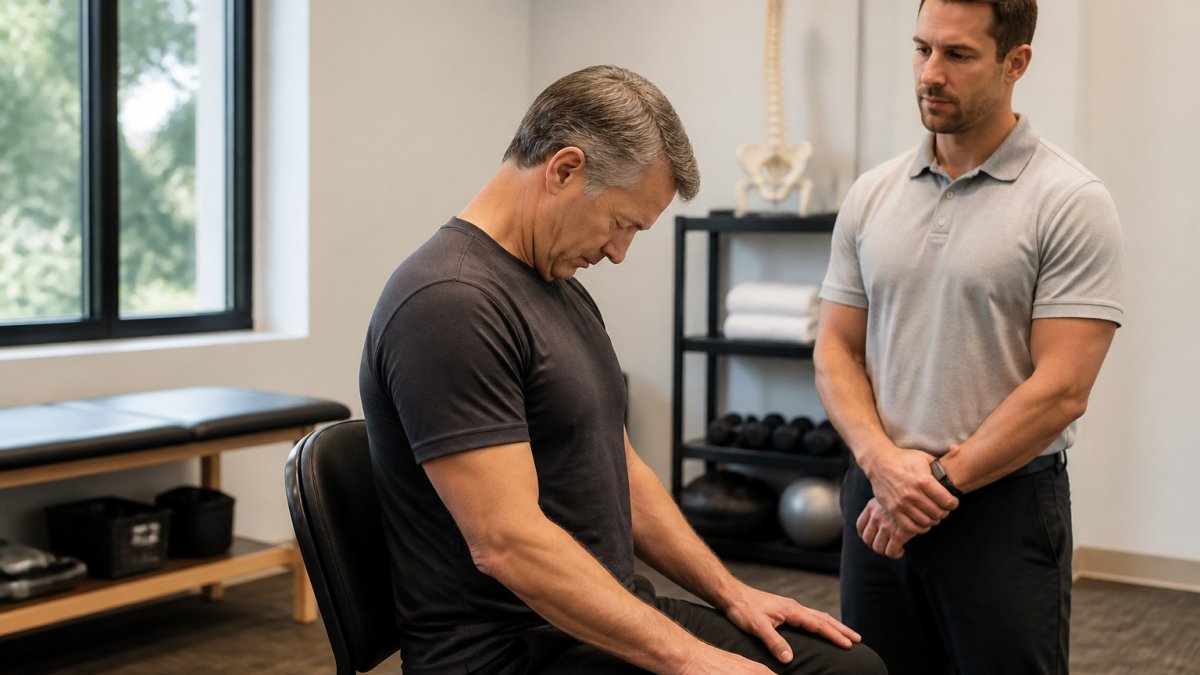
Cervical Retraction (Chin Tuck) in Sitting
- Sit tall in a firm chair with your shoulders relaxed and your feet flat on the floor.
- Look straight ahead, not up or down.
- Slide your head straight back over your shoulders, like you are making a double chin. Keep your eyes level.
- Hold for 2 seconds, then relax fully.
- Repeat 10 times, checking how your neck feels after each set.
Common form corrections:
- Do not tuck your chin down toward your chest, that is a different movement and can increase pain.
- Do not push your head back with your hand. The motion should come from your neck, not your arm.
- Keep your jaw relaxed. Clenching your teeth often means you are bracing instead of moving.
Neck Extension and Head Rotation in Lying
- Lie on your back with your head supported on a pillow. The pillow should be firm enough that your neck is not hanging.
- Let your head tip gently backward over the pillow edge. Move slowly, this is not a cranking motion.
- Hold for 2 seconds, then return to neutral.
- Add slow head rotation left and right if it feels comfortable.
- Repeat 10 times, watching for any change in arm symptoms.
Common form corrections:
- Do not force the end range. Stop where the movement feels easy, not where it feels blocked.
- Keep your shoulders down. Shrugging means you are compensating.
- If rotation makes you dizzy, skip it and stay with straight extension.
Accessible Alternatives If You Cannot Sit or Lie Comfortably
Not everyone can tolerate the standard positions. A common pattern is to modify the starting position rather than skip the exercise:
- Seated extension: Sit in a firm chair and gently look up toward the ceiling, keeping your chin slightly tucked. Hold 2 seconds. This is a smaller-range version of the lying extension.
- Standing retraction: Stand with your back against a wall, heels a few inches away. Gently slide your head back toward the wall without tilting your chin. This gives feedback that helps you avoid over-tucking.
- Side-lying retraction: Lie on your side with a pillow under your head. Gently glide your head back toward the pillow. This works well if lying flat on your back increases pain.
How to Choose Which Exercise to Start With
Exercise selection in MDT is not random. It follows the direction that reduces or centralizes your symptoms:
- If looking up or tipping your head back moves arm pain closer to your neck, extension is likely your directional preference.
- If tucking your chin reduces neck pain or makes arm symptoms retreat, retraction is likely your starting direction.
- If neither direction changes anything after several sets, do not keep guessing. That pattern usually means you need a clinician to assess which direction, or which combination, fits your problem.
How Many Repetitions and How Often
A common starting point is 10 repetitions every 2 to 3 hours, done 4 to 6 times a day. Some people respond better to fewer repetitions done more frequently; others need a slower start.
If a set makes your symptoms worse, reduce the range of motion, reduce the repetitions, or stop that direction and try the other one. If symptoms stay worse for more than a day after a session, do not repeat that session until you have been assessed.
How Long to Do McKenzie Neck Exercises: Repetitions, Sets, and Progression
How long you do McKenzie neck exercises depends on your symptom response, not a fixed calendar. A common starting point is 10 repetitions every 2 to 3 hours, done 4 to 6 times a day.
Progress in three stages:
| Stage | Repetitions | Frequency | Goal |
|---|---|---|---|
| Start | 10 | Every 2-3 hours | Learn the movement |
| Build | 10-15 | 4-6 times daily | Reduce symptoms |
| Maintain | 10 | 1-2 times daily | Prevent flare-ups |
Move to the next stage only when symptoms stay steady or improve. If they worsen, step back.
Grab a Free Discovery Call Today →
Safety Screening: Red Flags and Who Should Not Do McKenzie Exercises
Not everyone should do these exercises. Some people should not do McKenzie exercises at all, and others need medical clearance first. The distinction matters because the wrong exercise, done with good intentions, can irritate a nerve or delay necessary care.
Symptoms That Warrant Urgent Medical Assessment
Seek urgent medical evaluation, not a home exercise trial, if you have any of the following:
- Severe pain after a fall, motor vehicle collision, or other trauma
- Weakness or numbness that is getting worse rather than staying stable
- Loss of bladder or bowel control
These symptoms can indicate serious conditions that require imaging, laboratory work, or emergency care. Do not attempt self-directed neck exercises while you are waiting to be seen.
Who Should Modify or Avoid These Exercises Without Clearance
Even without the urgent red flags above, some situations call for clinician guidance before you start:
- Recent trauma or whiplash: The neck may need a period of protected movement before directional exercises are appropriate.
- Neurological symptoms: Numbness, tingling, or weakness in the arm or hand should be evaluated before you try to treat it yourself.
- Severe or worsening pain: If pain is escalating day by day, exercise is not the first step.
How to Decide Whether Self-Directed Exercise Is Appropriate
A simple decision rule helps:
- Green light: Mild to moderate neck pain or stiffness, no arm symptoms, no trauma, no neurological changes, and symptoms that stay the same or improve with gentle movement. Self-directed retraction and extension are reasonable to try.
- Yellow light: Arm pain that comes and goes, mild numbness, or pain that fluctuates with posture. You can try gentle retraction, but you should have a clinician confirm your directional preference within a week or two.
- Red light: Any urgent red flag, progressive weakness, or pain that worsens with every session. Do not self-treat. Get assessed.
What to Bring to a Clinician If You Are Unsure
If you fall into the yellow or red light categories, a short written summary helps your clinician move faster:
- When the pain started and what you were doing
- Where the pain sits and whether it travels into the arm
- What makes it better and what makes it worse
- Any numbness, tingling, or weakness
This is the same information an MDT assessment uses to classify your problem. Bringing it with you shortens the guesswork and helps ensure the exercise you end up doing is the right one for your pattern.
Tracking Your Response: How to Know If the Exercises Are Working
Track three things: where pain sits, how strong it is, and how far it travels. Write these down after each session. This is how you know whether to continue.
Good signs include:
- Arm pain moving closer to your neck
- Pain easing after a set
- Better neck movement
- Sleeping more comfortably
A simple daily log works. Note the time, the exercise, and the response. Bring it to your next visit.
Common Mistakes to Avoid With McKenzie Neck Exercises
The biggest mistake is doing the exercises without checking your response. Movement without feedback is just motion.
Other common errors:
- Cranking your head back too hard
- Skipping retraction and going straight to extension
- Doing one big set instead of several small ones
- Ignoring arm symptoms that spread
Conclusion: When to Seek Professional Assessment
Neck pain that spreads into your arm, keeps you awake, or fails to improve with home exercises needs a trained eye.
At Spinal Haven, our team uses the McKenzie Method and the Selective Functional Movement Assessment to find the root cause of your pain. We offer one-on-one sessions, in-person and virtual care, and a plan built around self-management so you are not stuck in endless appointments.
Frequently Asked Questions
Who should not do McKenzie exercises?
People with red flag symptoms should not start McKenzie exercises without medical clearance. These include severe or worsening neck pain, pain after a fall or accident, unexplained weight loss, fever, night pain that wakes you, numbness in both arms or legs, or loss of bladder or bowel control. Anyone with a recent fracture, spinal tumor, infection, or progressive neurological weakness should also avoid self-treatment. If you have osteoporosis, rheumatoid arthritis, or a history of cervical surgery, talk to a qualified clinician before trying these movements.
How do you know if a McKenzie neck exercise is helping?
A positive response usually shows up within 24 hours. Signs include arm pain or radiating pain moving closer to the neck (centralization), a wider range of neck movement, or less pain with the same activity. If symptoms spread further down the arm or leg, worsen, or new numbness appears, stop the exercise and seek assessment. Tracking your pain level before and after each set helps you spot patterns. Most people notice a clear direction within three to five sessions of repeated movements.
Should you see a physical therapist before trying McKenzie neck exercises?
It depends on your symptoms. For mild, recent neck stiffness without arm pain or red flags, gentle cervical retraction is generally safe to try. If you have radiating pain, numbness, weakness, or symptoms lasting more than two weeks, a clinical assessment helps identify your directional preference and rules out serious causes. A clinician trained in Mechanical Diagnosis and Therapy can classify your neck pain accurately, which matters because the wrong direction can make symptoms worse.
Is the McKenzie Method outdated?
No. MDT remains a widely used and researched approach in physical therapy. Studies on clinical effectiveness show it can reduce pain and improve function for many people with neck pain, especially when a clear directional preference is found. That said, evidence limitations exist: not everyone responds, and results vary by classification. The method works best as part of a broader plan that includes posture changes, scapular retraction, and spinal stabilization. It is one tool, not a cure for every case.