 How-to
How to Do McKenzie Exercises for Sciatica at Work
Last Updated: November 22, 2026
Quick Summary
McKenzie exercises for sciatica at work are simple movements you repeat at or beside your desk to see whether your leg pain moves closer to your spine. Stand and do a short set every 30 to 45 minutes, and stop any movement that sends leg pain farther down the leg.
- Avoid sitting in one position for more than 30 to 45 minutes.
- Do 5 to 10 repetitions of a movement, then re-check your leg symptoms.
- Centralization, where leg pain moves toward the spine, is generally a favorable sign.
- Stop any movement that spreads leg pain farther down the leg or increases numbness.
- Seek urgent care for bladder or bowel control loss, groin numbness, or rapidly worsening leg weakness.
Table of Contents
- What the McKenzie Method Is and How It Relates to Sciatica
- How to Sit at a Desk with Sciatica
- How to Relieve Sciatica Pain at Work: A Workday Movement Plan
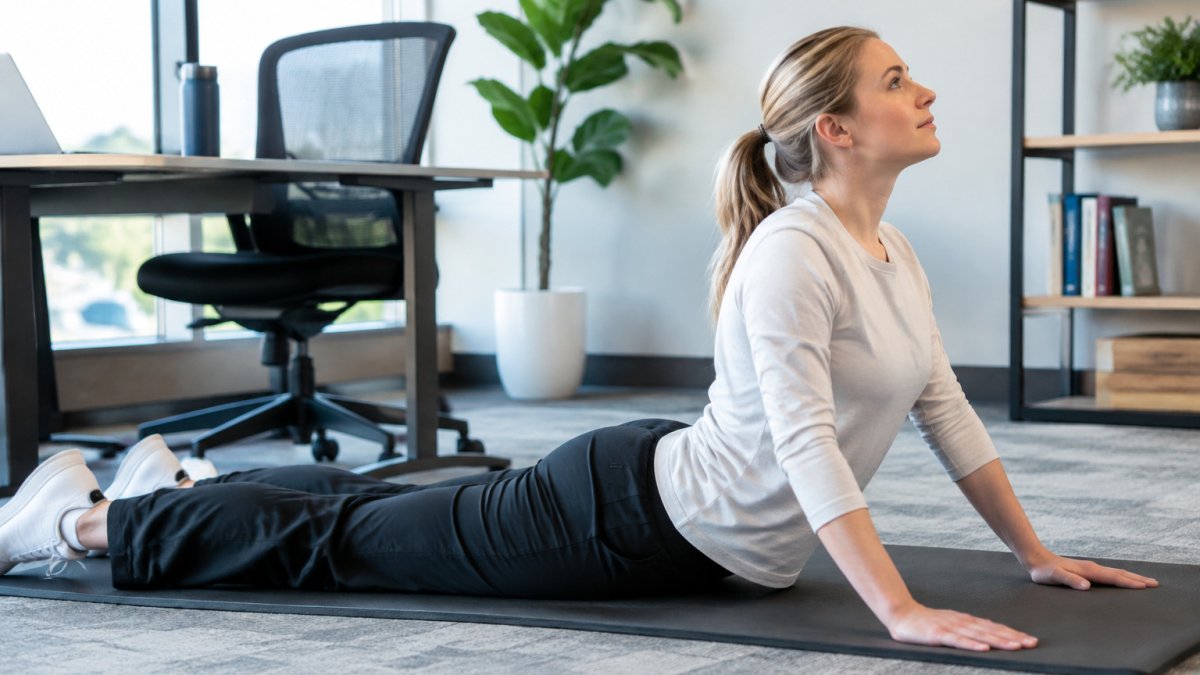
- Desk-Friendly McKenzie Exercises for Sciatica
- McKenzie Exercises for Herniated Disc: Safe Use and Stop Rules
- When Not to Do McKenzie Exercises and Red Flags That Need Urgent Care
- Booking a Discovery Call to Build Your Own Plan
- Frequently Asked Questions
Sitting at a desk all day can turn sciatica from an occasional nuisance into a constant problem. If you have leg pain, numbness, or tingling that starts in the lower back, a few simple McKenzie exercises may help you manage symptoms during the workday. The McKenzie Method is a approach that teaches people how their own movements change their symptoms. This guide walks through what the method is, how to set up your desk, and when to stop and get medical help.
What the McKenzie Method Is and How It Relates to Sciatica
The McKenzie Method, also called Mechanical Diagnosis and Therapy (MDT), is an approach to back and limb pain. For a detailed, step-by-step look at how it is applied to sciatica, see how the McKenzie Method is used for sciatica.
Sciatica is pain that travels along the sciatic nerve, often from the low back into the buttock and down the leg.
Research supports the approach. A systematic review and meta-analysis comparing the McKenzie method with manual therapy for chronic low back pain evaluated its effectiveness in people with chronic low back pain. Results vary between studies, so it works best as one part of a broader plan.
Self-treatment is the core of the method. Once you learn which movements help, you can repeat them at home or at work.
How to Sit at a Desk with Sciatica
Your sitting posture matters more than most people expect. Start with these basics:

- Sit with your hips slightly higher than your knees if your chair allows it.
- Keep both feet flat on the floor.
- Support the natural curve of your lower back with a small cushion or rolled towel.
- Position your screen at eye level so you are not hunched forward.
- Keep your keyboard close so your elbows stay near your sides.
Avoid sitting in one position for more than 30 to 45 minutes. Shift your weight, stand up, and move before pain builds. A standing desk or a desk riser lets you alternate between sitting and standing, which many people find easier on the back.
Watch out: Slouching in a soft chair with your legs stretched out can aggravate leg symptoms at work.
How to Relieve Sciatica Pain at Work: A Workday Movement Plan
Most people with desk-based sciatica do better with short, frequent movement breaks than with one long stretch session. The goal is to interrupt sustained sitting before symptoms build, not to exhaust yourself with exercise.
A sample workday schedule
- First hour: Before you sit down, do one set of your chosen movement (5 to 10 repetitions) standing beside your desk. Note where you feel symptoms.
- Every 30 to 45 minutes: Stand up, walk for 60 to 90 seconds, and repeat one set of your movement. If your job makes standing awkward, shift your weight from side to side and do a seated version instead.
- Mid-morning (around 10:00 a.m.): Take a 3- to 5-minute break for a slightly longer routine, such as standing extension followed by a short walk to the water cooler or printer.
- Lunch: Walk for 5 to 10 minutes before or after eating. Prolonged sitting at lunch undoes the benefit of your morning breaks.
- Mid-afternoon (around 2:00 to 3:00 p.m.): Repeat the 3- to 5-minute routine. This is when stiffness often peaks for desk workers.
- Last hour: Do one final set of gentle movements before you leave, and note whether your leg pain has moved closer to your spine, stayed the same, or spread farther down the leg.
Symptom check-ins
At each break, ask yourself three questions: Is my leg pain closer to my back than it was this morning? Is it farther down my leg? Is it unchanged? A pattern of movement toward the back (centralization) is generally a favorable sign and suggests you can continue the same direction.
Adapting the plan to your job
- Desk-based work: Use the schedule above. A standing desk or desk riser lets you alternate between sitting and standing, but standing still for long periods is not a substitute for walking.
- Driving or long meetings: You may not be able to stand every 30 minutes. In that case, do seated movements (such as seated extension or seated forward bending, depending on your symptom direction) and take the first available opportunity to walk.
- Standing work: If you are on your feet all day, your challenge may be too little sitting rather than too much. Use your breaks to sit briefly with good lumbar support and to do your chosen movement.
- Mobility limits: If you cannot safely get down to the floor, stick to standing and seated versions. Do not force a floor exercise that puts you at risk of falling.
Watch out: A common mistake is to do a long, intense routine once a day and sit unmoving the rest of the time. Frequency matters more than duration for most people with sciatica at work.
Desk-Friendly McKenzie Exercises for Sciatica
These movements can be done at or beside your desk. Stop any movement that makes your leg pain travel farther down the leg.
Standing Lumbar Extension at Your Desk
- Stand facing your desk with your feet about hip-width apart.
- Place your hands on your lower back or on the desk edge.
- Slowly lean back, bending gently at the lower back. Do not force the movement.
- Hold for two to three seconds, then return to standing.
- Repeat 5 to 10 times, watching whether your leg symptoms move closer to your spine.
Seated and Standing Forward-Bending Adaptations
If extension increases your symptoms, forward bending may be the better direction for you.
- Sit tall in your chair with your feet flat.
- Slowly lean forward, letting your arms hang toward the floor.
- Return to upright slowly.
- Repeat 5 to 10 times.
For a standing version, stand with your feet apart and bend forward at the hips with a soft knee bend. Keep the movement slow and controlled.
The movements below can be done at or beside your desk, and the article gives a clear stop signal for each.
| Movement | Repetitions | Stop if |
|---|---|---|
| Standing lumbar extension | 5 to 10 | Leg pain spreads farther down the leg |
| Seated forward bending | 5 to 10 | Leg pain spreads farther down the leg |
| Standing forward bending | 5 to 10 | Sharp pain lingers after finishing |
Repetitions
McKenzie Exercises for Herniated Disc: Safe Use and Stop Rules
Many people with sciatica have a disc bulge or herniation, and the McKenzie approach can be useful for some of them. The key principle is that the direction of movement matters, and the right direction is the one that moves your leg symptoms closer to your spine.
A simple self-assessment sequence
- Before you start, note where you feel symptoms: low back only, buttock, thigh, calf, or foot. Rate the leg pain from 0 to 10.
- Do one set of 5 to 10 repetitions of a single movement, such as standing extension.
- Re-check your symptoms. If the leg pain has moved closer to your back or decreased, that direction is likely helpful. If it has spread farther down the leg or increased, stop and try the opposite direction (for example, forward bending) on a separate trial.
- Wait at least 10 to 15 minutes before judging a movement, because symptoms can change after you stop.
- Keep a simple written log for a week: movement, repetitions, symptom location before and after, and overall pain rating. This log is what a clinician would use to guide your plan.
Stop rules
- Stop if leg pain spreads farther down the leg or into the foot.
- Stop if numbness or weakness increases.
- Stop if a movement causes sharp pain that lingers after you finish.
- Stop if symptoms feel worse the next morning.
- Stop if you develop any red-flag symptoms (see the next section).
General guidance versus individualized assessment
General guidance can help you start safely, but it cannot tell you which direction is right for your specific presentation. A clinician trained in the McKenzie Method uses repeated movements and symptom responses to classify your problem and prescribe a direction.
Watch out: Do not assume that because extension helps a friend with sciatica, it will help you. The same movement can centralize symptoms in one person and peripheralize them in another. If you are unsure, stop and get an assessment rather than guessing.
When Not to Do McKenzie Exercises and Red Flags That Need Urgent Care
Self-treatment is not right for everyone. If your symptoms are persistent or unclear, explore evidence-based sciatica physical therapy for a professional assessment. Do not start or continue these exercises without medical advice if you have any of the following:
- Loss of bladder or bowel control
- Numbness in the groin or inner thighs
- Rapidly worsening weakness in one or both legs
- Fever, unexplained weight loss, or severe night pain
- A recent injury, such as a fall or car accident
Seek urgent medical care right away if you notice any of these signs. Symptoms like these need prompt evaluation, not an exercise plan.
If your leg pain is persistent, keeps returning, or does not improve after a few weeks, schedule an evaluation. Sciatica physical therapy at Spinal Haven focuses on identifying the cause of your symptoms and building a plan you can manage on your own.
Booking a Discovery Call to Build Your Own Plan
Learning the McKenzie approach works best with guidance. A clinic-based McKenzie Method® service can teach you a personalized version of these movements, based on how your body responds.
If you want to see whether one-on-one care fits your situation, you can schedule a 15-minute discovery call with Dr. Elizabeth Kingshott Cary, PT, DPT, Cert. MDT. She is certified in the McKenzie Method, and Spinal Haven is the only clinician in Michigan trained in the Selective Functional Movement Assessment (SFMA) and certified in the McKenzie Method®, with both in-person and virtual options.
Stop struggling with sciatica at your desk. Book a discovery call with Spinal Haven and get a plan built around your work, your symptoms, and your goals.
Frequently Asked Questions
Does the McKenzie method work for sciatica?
The McKenzie Method is a classification-based approach that uses repeated movements and positions to find which direction reduces leg symptoms. Published studies have compared it with other treatments for back and leg pain, with mixed results. Results vary by person and by cause, so a physical therapist trained in the method can assess whether it fits your symptoms before you commit to a routine.
When should I avoid McKenzie exercises?
Stop and seek medical advice if leg pain worsens with a movement, if you notice new numbness, tingling, or weakness in the legs, or if you have loss of bladder or bowel control. Pain that moves farther down the leg during an exercise is also a reason to stop that movement. Anyone with a recent injury, a suspected fracture, or a condition affecting the spine should check with a clinician before starting any exercise program.
Can I do McKenzie exercises at my desk?
Some McKenzie-style movements can be adapted to a workday, such as standing lumbar extension while holding the desk edge and seated positioning that supports the lower back. Keep movements small, perform them slowly, and stop if symptoms move farther down the leg. Adjust your workstation so your screen is at eye level and your hips sit slightly above your knees, which reduces repeated strain during long sitting periods.
How should I sit at my desk with sciatica?
Sit with your feet flat on the floor, your knees about level with your hips, and your lower back supported by the chair or a small lumbar roll. Keep the screen at eye level so you are not craning your neck, and change position every 30 to 60 minutes. If sitting consistently worsens leg symptoms, use a standing break or a sit-stand setup and talk with a physical therapist about a plan that fits your job.