 How-to
5 Gentle Yoga Moves to Calm Spinal Inflammation
Last Updated: November 27, 2026
Quick Summary
Gentle yoga may help calm spinal irritation through slow movement and breath, but it is a supportive tool, not a cure. A systematic review found one yoga intervention produced twice the pain reduction of an educational control group. Start slowly, avoid poses that sharpen pain, and see a clinician for persistent or serious symptoms.
- Yoga for back pain showed twice the pain reduction versus an educational control group in one review.
- Start with small ranges of motion and stop any pose that sharpens pain or causes numbness.
- A 5-minute routine of cat-cow, child's pose, bridge, knee-to-chest and seated rest fits a busy day.
- Seek medical care for leg numbness, weakness, bladder or bowel changes, or pain after a fall.
- Track pain, sleep and energy over several weeks to see which poses actually help.
Table of Contents
- What Spinal Inflammation Means and What Gentle Yoga Can and Cannot Do
- Yoga for Lower Back Pain Beginners: Setting Up Safely
- 5 Minute Yoga for Lower Back Pain: A Time-Bounded Gentle Routine
- Yoga Poses for Lower Back Pain and Sciatica, With Modifications
- Yoga for Back Pain Relief at Home: Building a Sustainable Practice
- Safety Precautions, Red Flags, and When to See a Clinician
- Booking a Discovery Call to Build Your Self-Management Plan
- Frequently Asked Questions
What Spinal Inflammation Means and What Gentle Yoga Can and Cannot Do
Spinal inflammation is the body's response to irritation in the tissues around the spine, and gentle yoga may help calm some of that irritation through movement and breath. At Spinal Haven, we see many professionals in Michigan who want a practical way to ease back discomfort without giving up their busy schedules. A systematic review of yoga for chronic low back pain found that one yoga intervention produced twice the reduction in pain compared with an educational control group, and it also reduced pain-medication use (Yoga as a treatment for chronic low back pain: A systematic review of the literature).
Here is the honest picture. Gentle yoga is a supportive tool, not a cure. The mechanisms behind yoga's benefits are still not well understood, as a 2013 study of yoga and stretching for chronic low-back pain noted (Mediators of yoga and stretching for chronic low-back pain).
What gentle yoga can do:
- Encourage slow, controlled movement through the spine
- Build awareness of posture and breathing
- Offer a low-impact routine you can repeat at home
What gentle yoga cannot do:
- Replace a medical assessment of the cause of your pain
- Guarantee relief for every type of back problem
- Fix a serious condition on its own
Some people with back pain are told a yoga class can be as helpful as physical therapy, while experts also stress gentle practice and careful pose selection (NPR Health Shots coverage of yoga for back pain). Keep that balance in mind as you read.
Yoga for Lower Back Pain Beginners: Setting Up Safely
Yoga for lower back pain beginners works best when you start slow and choose poses with care. Many people rush in and push too hard, which can make pain flare.
Before you begin, set up your space:
- Use a non-slip mat on a firm, flat floor
- Keep a folded blanket, a pillow and a bolster nearby
- Wear comfortable clothing that lets you move freely
- Pick a quiet time when you will not be rushed
Move in small ranges. Stop any pose that sharpens pain, causes numbness, or sends pain down your leg. Ease out and rest. Gentle means you stay in control the whole time.
5 Minute Yoga for Lower Back Pain: A Time-Bounded Gentle Routine
A 5 minute yoga for lower back pain routine fits into a busy workday, and a short, sequenced session is easier to repeat than a long one you skip. The order below matters: it starts with gentle spinal movement, moves into a supported rest, adds a low-load hip and back activation, then finishes with a decompressing stretch and a breathing close. Move slowly enough that each breath lasts about four to six seconds, and keep every range comfortable rather than maximal.
- Cat-Cow (about 60 seconds, 6-8 slow rounds). Start on hands and knees with wrists under shoulders and knees under hips. Inhale as you arch gently and lift the chest; exhale as you round and tuck the chin. Keep the movement small and smooth. Easier option: do the same motion seated in a chair, hands on thighs.
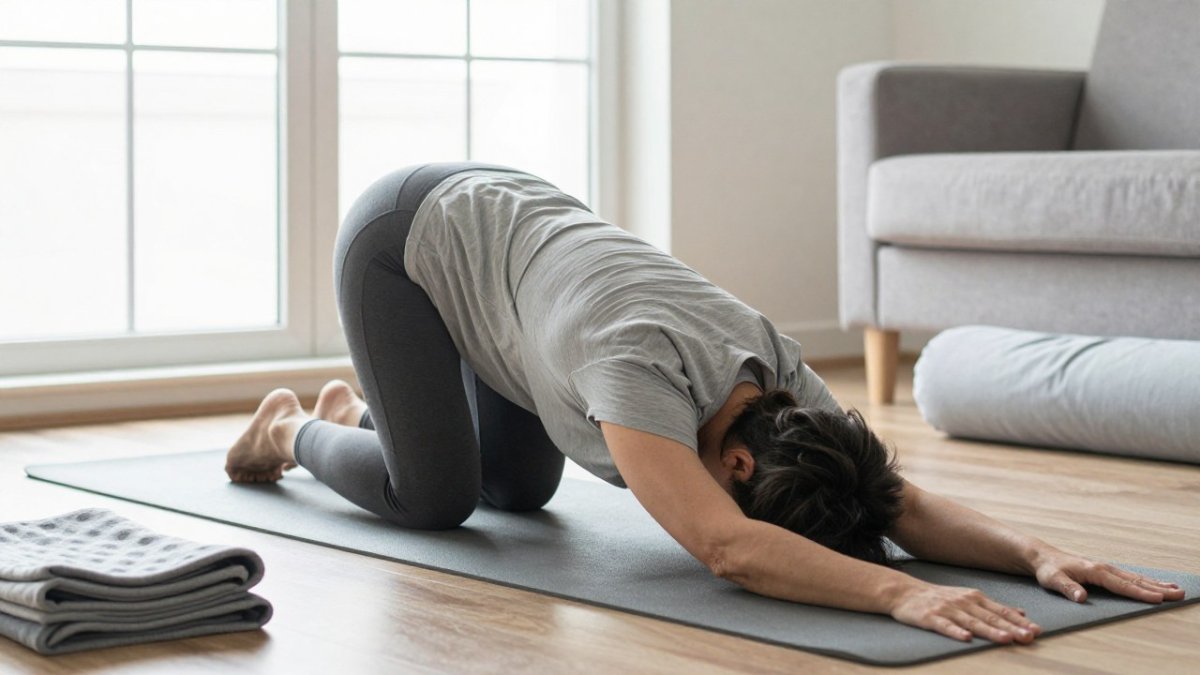
- Child's Pose (about 60 seconds, 2-3 breaths per hold). Sit back toward your heels with arms forward and forehead supported. If your hips or knees feel tight, place a pillow or folded blanket under your hips or between your calves and thighs. Easier option: rest your forearms on a chair seat and hinge forward from the hips.
- Bridge pose (about 60 seconds, 3-5 slow lifts). Lie on your back with knees bent and feet hip-width apart. Press through the feet and lift the hips only as high as feels comfortable, hold for one breath, then lower slowly. Easier option: skip the lift and simply press the feet down and gently engage the glutes.
- Knee-to-chest stretch (about 60 seconds, 20-30 seconds per side). Hug one knee toward your chest, keeping the other foot on the floor or bent. Switch sides. Easier option: keep both feet on the floor and rock the knees gently side to side.
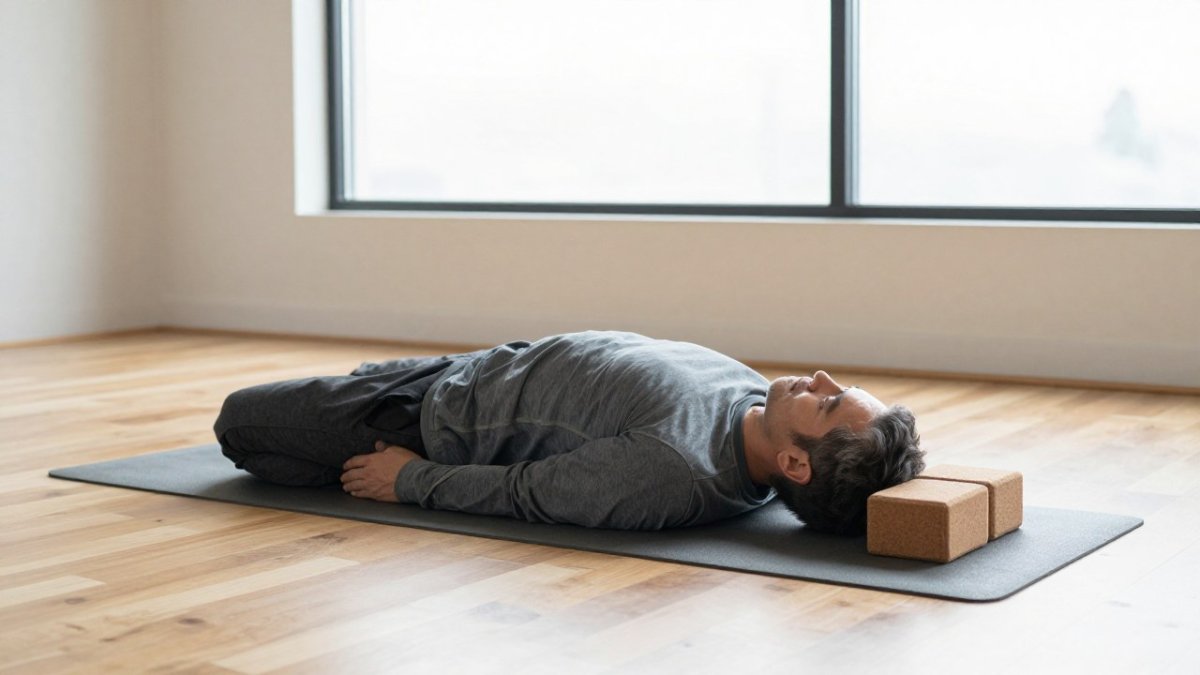
- Easy seated rest (about 60 seconds). Sit tall on a chair or cushion, hands on thighs, and breathe slowly through the nose. Let the exhale be slightly longer than the inhale.
Rest between poses as needed, and stop the sequence early if any movement sharpens pain. Repeat the full routine once or twice a day, and note how you feel before and after each session so you can adjust the duration or swap in easier options. Watch out: if a pose sends pain down your leg or causes numbness, ease out and skip that pose on the next round rather than pushing through it.
Each pose in this short routine has a set time and a gentler option, so you can scale it to your day.
| Pose | Time | Easier option |
|---|---|---|
| Cat-Cow | About 60 seconds, 6-8 rounds | Same motion seated in a chair |
| Child's Pose | About 60 seconds, 2-3 breaths per hold | Forearms on a chair seat |
| Bridge pose | About 60 seconds, 3-5 slow lifts | Gentle glute squeeze, no lift |
| Knee-to-chest stretch | About 60 seconds, 20-30 seconds per side | Rock knees side to side |
| Easy seated rest | About 60 seconds | Not applicable |
Yoga Poses for Lower Back Pain and Sciatica, With Modifications
Yoga poses for lower back pain and sciatica need modifications for most people, and the right modification depends on what is driving the symptoms. A pose that suits nonspecific low back pain may not suit a diagnosed disc, joint, or nerve condition, so treat the options below as starting points and let your response guide you.
- Cat-Cow. On hands and knees, move slowly between a gentle arch and a gentle round. Keep the range small and lead with the breath. Modification for a flare-up: reduce to a seated version in a chair, or limit the motion to the pelvis only. Watch out: if arching reproduces sharp pain, stay in the rounded position and breathe there instead.
- Child's Pose. Kneel and sit back toward your heels, arms forward, forehead supported. Place a bolster or pillow under your chest if your hips feel tight, or under your hips if your knees complain. Modification for limited knee flexion: do the same shape with forearms on a chair seat and hips hinged back.
- Bridge pose. Lie on your back, knees bent, feet hip-width. Press through the feet and lift the hips only as high as comfortable, then lower slowly. Modification for sciatica that worsens with extension: keep the lift very small or substitute a gentle glute squeeze with the hips down.
- Sphinx pose. Lie on your stomach and prop on your forearms, elbows under shoulders. Keep the neck long and the lower back relaxed. Modification if this position provokes leg symptoms: place a pillow under the chest to reduce the extension, or skip it and use a prone rest with the forehead on the hands.
- Seated forward stretch. Sit on a folded blanket and hinge from the hips rather than rounding the lower back. Modification for tight hamstrings: bend the knees generously and reach only to mid-shin.
- Downward-Facing Dog. From hands and knees, lift the hips and lengthen the spine. Modification for tight hamstrings or wrists: bend the knees, use a wall or chair for the hands, or substitute a standing forward hinge with hands on a counter.
Sciatica can have many causes, so a clinician should guide any stretch that aggravates leg symptoms. A common pattern is that positions which extend the spine feel worse for some people and better for others, which is why your own response matters more than a generic list. Track which poses ease symptoms and which provoke them, and bring that record to a clinician if leg pain persists.
Yoga for Back Pain Relief at Home: Building a Sustainable Practice
Yoga for back pain relief at home works best when you build a routine you can keep. Consistency matters more than intensity.
Start with two or three short sessions each week. Add a day when you feel steady. Keep a simple log of your pain level, sleep and energy. Over several weeks, that record shows what helps and what does not.
Many people find that a home routine works well alongside hands-on care. If your progress stalls, a clinician can help identify what the home routine is missing. Speak with a qualified professional if self-care alone is not enough.
Safety Precautions, Red Flags, and When to See a Clinician
Safety comes first with any back-focused movement. Older adults can get hurt in yoga, so take extra care and adjust poses to your body (Harvard Health guidance on yoga injuries).
Stop and seek medical care if you notice:
- Pain that is severe, worsening, or does not ease with rest
- Numbness, tingling, or weakness in a leg or foot
- Loss of bladder or bowel control
- Pain after a fall or injury
- Fever with back pain
For persistent pain, a clinician can assess the cause through a professional one-on-one assessment. A movement-based assessment can help find the root cause of pain rather than only where it hurts. Spinal inflammation discussed here is a general concept; only a qualified clinician can confirm what is happening in your spine.
For more practical strategies, read 9 ways to manage back pain during long workdays, which covers habits that may calm lower back irritation.
Booking a Discovery Call to Build Your Self-Management Plan
Gentle yoga can be one useful part of managing back pain, but a plan built around your own movement tends to work best. Spinal Haven offers one-on-one physical therapy for back pain, neck pain and sciatica, with a focus on helping you manage movement on your own over time. Our clinician is trained in the Selective Functional Movement Assessment and certified in the McKenzie Method, and sessions are available in person or virtually.
To find out whether one-on-one care fits your situation, book a discovery call with our team. We will listen to your history, explain your options and help you decide your next step.
Frequently Asked Questions
Can gentle yoga help with back pain?
Gentle yoga may help some people with chronic low back pain. A systematic review of the literature reported that one yoga intervention produced twice the pain reduction and reduced pain-medication use compared with an educational control group. Evidence on mechanisms is still limited, and results vary between people. Start with slow, supported movements, stop if pain sharply increases, and talk with a licensed clinician before starting, especially if you have a known spinal condition or new symptoms.
Which yoga should not be done with back pain?
Avoid forceful twists, deep backbends, and fast, bouncing movements when your back is irritated. Older adults can be injured by yoga, so poses should be selected or modified rather than assumed safe for everyone. Skip any pose that sends pain or tingling down a leg, and check with a clinician if you have osteoporosis, recent surgery, or unexplained symptoms before trying more demanding poses.
How long should a gentle yoga routine for back pain last?
A short routine of about five minutes can be a reasonable starting point, performed once or twice daily, with slow breathing and a few seconds held in each pose. Many people build up gradually as tolerated. Track how your pain and stiffness respond over several days, and adjust duration rather than pushing through discomfort. Longer sessions are not automatically better for spinal inflammation.
Can yoga help with lower back pain and sciatica?
Yoga may help some people manage lower back pain, and a gentle practice may ease stiffness that accompanies sciatica for certain individuals. Sciatica involves nerve symptoms, so poses that aggravate leg pain, numbness, or weakness should be avoided. Work with a qualified clinician to identify the cause of your symptoms and to determine which movements are appropriate for your situation.