 Ultimate guide
The Professional's Guide to Preventing Chronic Back Pain
Last Updated: November 7, 2026
Quick Summary
Preventing chronic back pain in professionals comes down to a handful of habits built into an ordinary workday: an ergonomic workstation, short daily exercise, and frequent movement breaks. Schedule movement the same way you schedule meetings, getting up every 30 to 45 minutes. Consistency generally matters more than intensity.
- Set your monitor so the top of the screen sits near eye level, roughly an arm's length away.
- A daily five-minute sequence targets hip flexors, thoracic spine, and glutes, performed once or twice per day.
- Stand during phone calls and set a reminder to get up every 30 to 45 minutes.
- Bend at the hips and knees, keep the load close, and avoid twisting while carrying.
- Track one adherence number, such as days per week of movement breaks, and review it monthly.
Table of Contents
- Why Chronic Back Pain Sidelines Professionals
- How to Prevent Lower Back Pain with an Ergonomic Workstation Setup for Back Pain
- Office Exercises for Back Pain Prevention You Can Do Between Meetings
- How to Prevent Lower Back Pain During Long Workdays
- Physical Therapy for Chronic Back Pain: What to Expect
- Early Warning Signs and When to Seek Care
- Building a Measurable Prevention Plan That Fits Your Role
- Book a Discovery Call with Spinal Haven
- Frequently Asked Questions
Why Chronic Back Pain Sidelines Professionals
Preventing chronic back pain in professionals starts with understanding what makes desk-bound work so hard on the spine. Research on occupational back pain generally points to job demands, sustained postures, and the way work is organized as factors that shape risk. For people who spend their days in meetings, on calls, or at a keyboard, the problem is rarely one dramatic injury. It is the accumulation of small loads repeated for years.
Many high-performing professionals push through discomfort until it starts interfering with work and family life. The good news is that most prevention comes down to a handful of habits you can build into an ordinary workday.
How to Prevent Lower Back Pain with an Ergonomic Workstation Setup for Back Pain
An ergonomic workstation setup for back pain is less about buying gear and more about matching your equipment to your body. Get the fundamentals right and you remove hours of unnecessary strain every week.
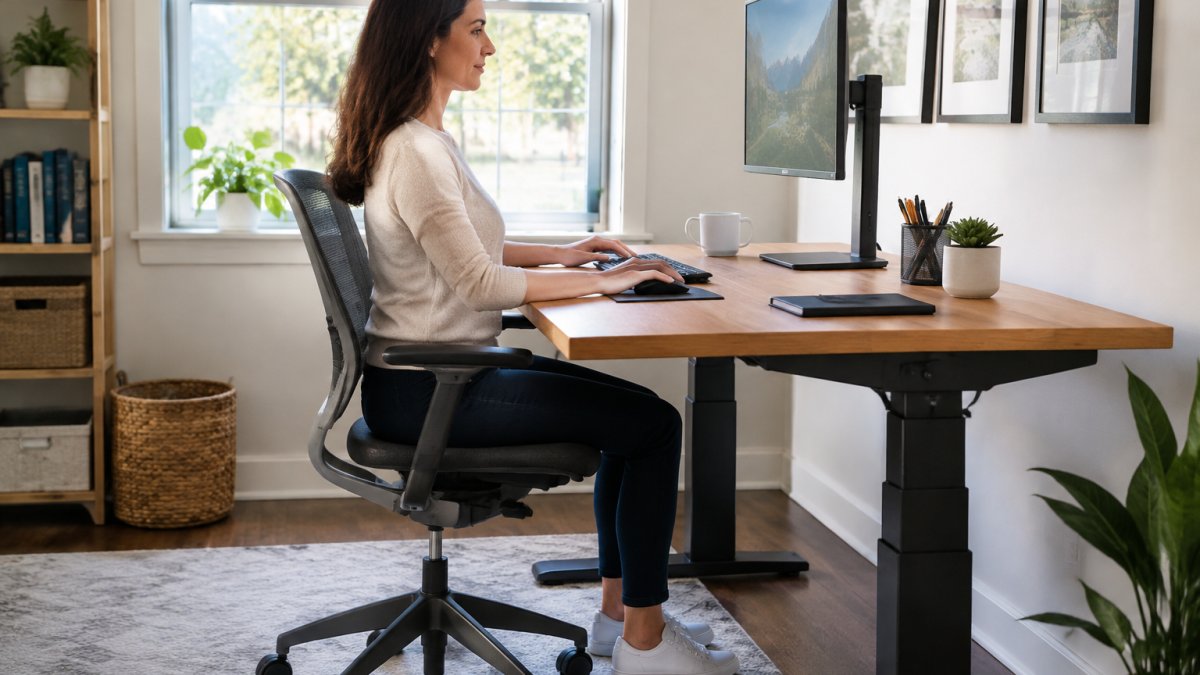
Start with these adjustments:
- Set your monitor so the top of the screen sits near eye level, roughly an arm's length away.
- Position your keyboard and mouse so your elbows rest near 90 degrees and your wrists stay neutral.
- Choose a chair that supports your lower back and allows your feet to rest flat on the floor.
- Keep frequently used items within easy reach to avoid repeated twisting.
Desk work also encourages rounded shoulders, which feed into neck and upper back tension over time. Our guide on how to fix rounded shoulders from desk work walks through practical corrections you can make today.
Office Exercises for Back Pain Prevention You Can Do Between Meetings
Office exercises for back pain prevention work best when they are short, frequent, and progressive.
Start with a five-minute daily sequence that targets the areas most affected by desk work: hip flexors, thoracic spine, and glutes. Perform each movement for the prescribed reps or hold, moving slowly and breathing steadily.
Daily five-minute sequence (perform once or twice per day):
- Standing extension: stand tall, place your hands on your lower back, and gently arch backward 8 to 10 times. This counteracts sustained flexion from sitting.
- Seated thoracic rotation: sit upright with feet flat, rotate your upper body to each side 8 to 10 times per side, holding briefly at end range. This restores mid-back mobility that stiffens during keyboard work.
- Hip flexor stretch: step one foot back into a gentle lunge, tuck your pelvis slightly, and hold for 20 to 30 seconds per side. Tight hip flexors from prolonged sitting pull on the lower back.
- Shoulder blade squeeze: pull your shoulder blades together and down, hold for five seconds, and repeat 10 times. This offsets rounded shoulders and upper back tension.
- Glute bridge: lie on your back with knees bent, squeeze your glutes to lift your hips, and hold for two seconds at the top for 10 to 12 reps. Strong glutes support the lower back during lifting and walking.
Progression for weeks two through four: add a resistance band for the shoulder blade squeeze and perform the glute bridge with a two-second pause at the top. Increase to two rounds of the sequence if your schedule allows. A 2024 review of clinical practice guidelines summarized in a 2024 review of clinical practice guidelines recommends therapeutic exercise as part of managing chronic low back pain, which supports making these small daily doses a permanent habit rather than a temporary fix.
Tracking adherence: use a simple calendar or habit app to mark each day you complete the sequence. Aim for at least five days per week.
Adapting to your work pattern: if you travel frequently, you can perform the standing extension and shoulder blade squeeze in your hotel room or at an airport gate.
If stiffness and weakness keep limiting your activity, our mobility and movement restoration program is built to address exactly that.
How to Prevent Lower Back Pain During Long Workdays
Learning how to prevent lower back pain during long workdays comes down to breaking up the load. Prolonged sitting is a major contributor, and the fix is not a perfect posture you hold for eight hours. It is variety.
Movement Breaks That Fit a Packed Calendar
Schedule movement the same way you schedule meetings. Stand during phone calls, walk during a coffee refill, and set a reminder to get up every 30 to 45 minutes. UCHealth recommends rotating heavy work and building in breaks as employer actions that help prevent chronic back pain, and the same principle applies to your own calendar.
Safe Lifting and Carrying for Hybrid Workdays
Hybrid schedules often mean lifting at home and at the office. Bend at the hips and knees, keep the load close to your body, and avoid twisting while carrying. If a load feels heavy, ask for help or use a cart. A common mistake is lifting with a rounded back after hours of sitting, when your muscles are least prepared for the effort.
Physical Therapy for Chronic Back Pain: What to Expect
Physical therapy for chronic back pain is an active, movement-based process rather than a passive treatment you receive. A good program starts with a thorough assessment, then builds an individualized exercise plan you practice between visits.
At Spinal Haven, our one-on-one evaluations use movement-based assessment to identify the root cause of symptoms rather than only treating where it hurts. Sessions are personalized, and the goal is to teach you self-management strategies so you are not dependent on endless appointments. If you want to see how this works in practice, you can review our back pain physical therapy services.
Early Warning Signs and When to Seek Care
Most everyday back pain settles with movement and time. Some symptoms need prompt medical attention, and it is worth knowing the difference.
Seek care quickly if you notice:
- Pain that follows a fall or impact
- Weakness, numbness, or loss of bladder or bowel control
- Pain accompanied by fever or unexplained weight loss
- Symptoms that steadily worsen despite rest and activity changes
For persistent pain that limits your work or exercise, an evaluation can clarify what is driving it. You can read answers to common questions about visits and what to expect on our frequently asked questions page.
Building a Measurable Prevention Plan That Fits Your Role
A prevention plan only works if it fits how you actually work and accounts for the factors that drive back pain beyond posture and lifting.
Step 1: Identify your role pattern and main risk. Use the table below to match your work pattern to the most likely contributor and a daily habit that addresses it.
| Role Pattern | Main Risk | Daily Habit to Add | Weekly Target |
|---|---|---|---|
| Desk-heavy professional | Prolonged sitting, rounded shoulders | Movement break every 30-45 minutes | 3 strength sessions |
| Hybrid worker | Mixed sitting and lifting | Safe lifting technique at home and office | 2 mobility sessions |
| Travel-heavy professional | Long drives, poor sleep | Standing stops and hotel-room stretching | 150 minutes activity |
| Manual or mixed labor | Repetitive heavy loads | Task rotation and supported lifting | 2 recovery days |
Step 2: Address psychosocial and organizational factors. Most practitioners find that stress and job strain amplify pain perception and make it harder to stick to prevention habits.
Step 4: Know the evidence quality. Not all prevention advice is equally supported.
Step 5: Plan for recurrence. After an episode of back pain, return to activity gradually rather than waiting for pain to disappear completely.
Book a Discovery Call with Spinal Haven
Preventing chronic back pain takes consistency, and the right plan makes consistency far easier. If you have tried general physical therapy without lasting relief, a one-on-one approach built around your movement and your work may be a better fit.
Spinal Haven offers personalized, one-on-one physical therapy with movement-based assessment and a focus on long-term self-management, available in person and virtually. Dr. Elizabeth Kingshott Cary, PT, DPT, Cert. MDT, is trained in SFMA and certified in the McKenzie Method®.
You can schedule a discovery call to see whether this approach suits your situation.
If back pain is already shaping your workday, the next step is a conversation, not another round of guesswork. Spinal Haven combines the McKenzie Method® and SFMA to find what is actually driving your symptoms and to give you tools you can use on your own.
Frequently Asked Questions
What causes chronic back pain in professionals?
Chronic back pain in professionals often develops from prolonged sitting, repetitive desk tasks, and weak supporting muscles. Research on occupational back pain commonly highlights prevention approaches such as workstation adjustments and movement breaks. Psychosocial factors like job stress and low control over work schedules also play a role. Addressing these risk factors early can help prevent acute discomfort from becoming chronic back pain.
How can I prevent lower back pain at work?
Start with an ergonomic workstation setup for back pain: monitor at eye level, feet flat, chair supporting your lower back. Take regular movement breaks every 30 to 60 minutes, even if just for a minute of standing or walking. Add office exercises for back pain prevention, such as seated pelvic tilts and standing extensions, into your day. Therapeutic exercise is a common part of managing chronic low back pain, and consistency generally matters more than intensity.
Can sitting all day cause chronic back pain?
Prolonged sitting can contribute to chronic back pain by loading the spine statically and weakening supporting muscles. Changing work patterns and adding breaks are often cited as workplace measures that can help prevent chronic back pain. Sitting itself is not the sole cause, but combining long sedentary periods with poor posture and lack of physical activity raises your risk. Alternating sitting and standing, plus regular movement, reduces that risk.
What is the best desk setup for preventing back pain?
An ergonomic workstation setup for back pain includes a chair with lumbar support, a monitor positioned so the top of the screen is at or slightly below eye level, and a keyboard and mouse that keep your elbows near 90 degrees. Keep your feet flat on the floor or on a footrest. Adjust your desk height so your wrists are straight. These adjustments reduce sustained strain, but they work best alongside movement breaks and strengthening exercises.
When should I see a physical therapist for back pain?
See a physical therapist if back pain lasts more than a few weeks, recurs frequently, or limits your daily activities. Research on prevention and management of non-specific low back pain generally supports early conservative care. Signs like pain radiating down the leg, numbness, or weakness warrant a prompt evaluation. Physical therapy for chronic back pain can identify root causes and build a personalized plan before symptoms worsen.
What exercises can help prevent back pain?
Focus on core strength, hip mobility, and spinal endurance. Examples include pelvic tilts, bird-dog, dead bug, and gentle cat-cow stretches. Therapeutic exercise is commonly recommended for chronic low back pain. Start with 5 to 10 minutes daily and progress gradually. Office exercises for back pain prevention, like seated marches and standing extensions, can be done at your desk. A physical therapist can tailor an individualized exercise program to your needs.
Can workplace changes help reduce recurring back pain?
Yes. Rotating heavy-work schedules and instituting breaks are often cited as employer actions that can help prevent chronic back pain. For desk-based professionals, workplace adjustments like adjustable desks, supportive chairs, and scheduled movement breaks can reduce strain. A biopsychosocial approach that addresses job demands, stress, and work schedules is often considered alongside ergonomics. Discuss feasible accommodations with your employer or occupational health contact.