 how-to
How to Fix Rounded Shoulders from Desk Work
Table of Contents
- What Rounded Shoulders Are and Why Desk Work Causes Them
- Common Causes and Effects of Poor Desk Posture
- Stretches for Rounded Shoulders: A Daily Routine
- Rounded Shoulders Exercises for Strength and Mobility
- Desk Ergonomics for Posture: Workstation Setup
- How Long to Correct Rounded Shoulders: Timeline and Progress
- When to Seek Professional Help
- Frequently Asked Questions
Last Updated: October 7, 2026
What Rounded Shoulders Are and Why Desk Work Causes Them
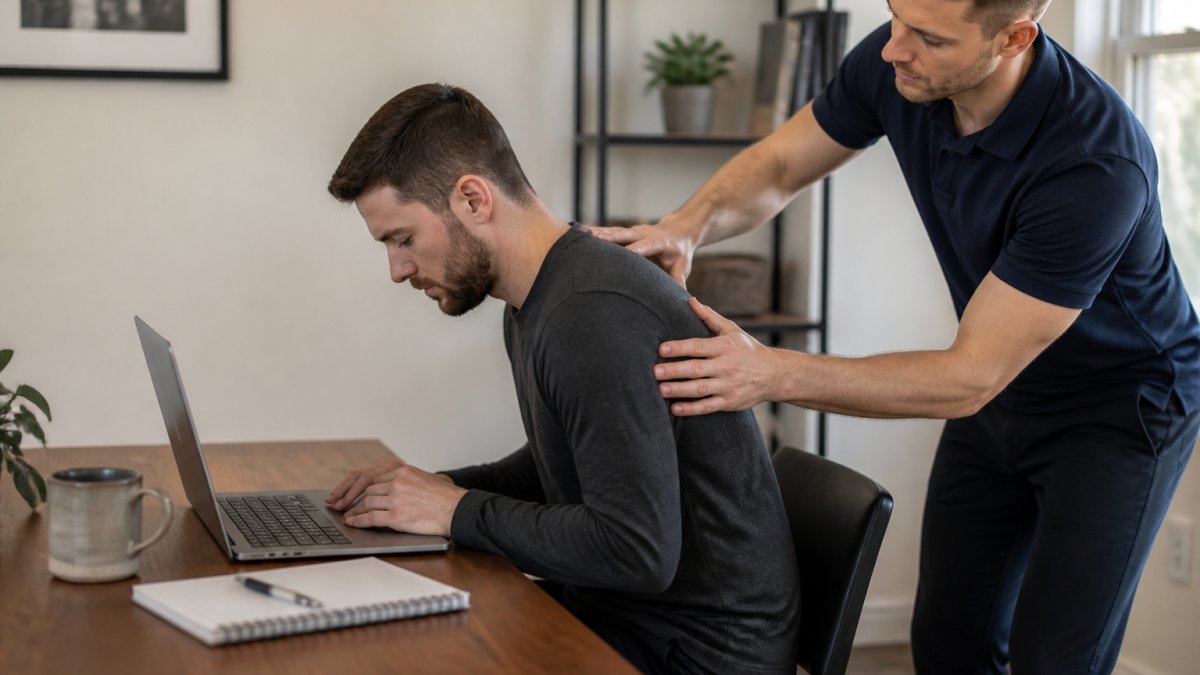
Rounded shoulders occur when your shoulder blades tip forward and your shoulders curve inward. This shift happens gradually over months and years of desk work as your body adapts to the slouched position, producing visible rounding at the top of your back and a forward-leaning posture that feels normal, even though it isn't.
Professionals spend eight or more hours daily hunched over keyboards, and the body responds by shortening front muscles and lengthening back muscles. This imbalance is biomechanics, not laziness.
The mechanics of slouching and forward-head posture
When you slouch, your head drifts forward to keep eye contact with your screen. This forward-head posture adds pressure to your neck and upper back: chest muscles tighten, upper back muscles weaken, and deep stabilizers like the cervical flexors stop firing properly.
Over time, your nervous system accepts this position as "normal" and postural awareness fades. That's why "sit up straight" rarely works, your muscles have forgotten how to hold better posture.
Muscle imbalances from prolonged sitting
Prolonged sitting creates predictable imbalances: chest muscles tighten, shoulder blades lose mobility, the upper back weakens, and neck extensors fatigue.
The deeper issue is activation. Your scapulae stop moving properly, the muscles that should retract them become underactive, and your pectoralis muscles stay chronically tight, pulling your shoulders forward.
This imbalance doesn't fix itself, and stretching alone won't solve it. You need to strengthen weakened muscles and release tightened ones.
Common Causes and Effects of Poor Desk Posture
Poor desk posture stems from one primary culprit: your workstation setup. Monitor height, keyboard position, chair adjustment, and desk depth all influence how your body positions itself, and when they're misaligned you compensate by rounding your shoulders and leaning forward.
The effects ripple through your body: neck pain first, then upper back tension, then headaches. Some people develop thoracic pain, a sharp ache between the shoulder blades.
How desk ergonomics contribute to rounded shoulders
Your monitor position matters more than most people realize.
Keyboard and mouse position matters equally: too high and your shoulders shrug upward, too low and you hunch forward. Chair height influences everything else, too low and your knees angle upward, your pelvis tilts back, and you slouch.
These aren't minor adjustments. They're the foundation of whether rounded shoulders develop or not.
Pain and warning signs to watch for
Watch for these signals:
- Tension or tightness between your shoulder blades
- Neck stiffness that worsens as the day progresses
- Headaches that start at the base of your skull
These signs mean your muscles are fatiguing from poor positioning. Ignoring them lets the pattern become more ingrained.
Stretches for Rounded Shoulders: A Daily Routine
Stretching alone won't fix rounded shoulders, but it's a critical part of the solution. Tight muscles limit mobility and prevent your shoulder blades from moving freely, so a daily routine opens the front of your chest and releases tension in your neck and upper back.
Perform these stretches once daily. Hold each for 30 seconds. Breathe steadily throughout. Do not bounce or force the stretch past mild discomfort.
Doorway chest stretch
This stretch targets your pectoralis muscles, the chest muscles pulling your shoulders forward.
How to perform it:
- Stand in a doorway with your feet about hip-width apart
- Raise your right arm to shoulder height, elbow bent at 90 degrees
- Place your forearm on the doorframe
- Step forward gently until you feel a stretch across your chest
- Keep your shoulders relaxed, don't shrug upward
- Hold for 30 seconds
- Repeat on the left side
You should feel the stretch across the front of your shoulder and upper chest. If you feel it in the shoulder joint itself, back off slightly.
Neck and upper-back stretches
Your neck extensors and upper trapezius tighten from forward-head posture. These stretches release that tension.
Neck stretch (lateral flexion):
- Sit upright in your chair
- Drop your right ear toward your right shoulder
- Use your right hand to gently guide your head, do not force it
- Hold for 30 seconds
- Repeat on the left side
Upper trapezius stretch:
- Sit upright
- Reach your right arm behind your back
- Grasp your right wrist with your left hand
- Gently pull your right arm across your body
- Tilt your head slightly to the left
- Hold for 30 seconds
- Repeat on the other side
These stretches should feel mild. Never force them to the point of sharp pain.
Rounded Shoulders Exercises for Strength and Mobility
Stretching opens tight muscles; exercises strengthen weak ones. Together they rebalance your posture. Focus on movements that activate your upper back and shoulder blade muscles, the ones that have become underactive from desk work.
Perform these exercises 4-5 times per week, morning or evening, consistency matters more than timing. Start with lighter resistance and perfect your form before increasing difficulty.
Scapular squeeze and shoulder blade activation
This exercise awakens your shoulder blade muscles. It's simple but effective.
How to perform it:
- Stand with your arms at your sides
- Squeeze your shoulder blades together as if trying to hold a pencil between them
- Hold the squeeze for 2 seconds
- Release slowly
- Repeat for 15 repetitions
Do it slowly and feel your upper back engage. Slow, controlled repetitions build better awareness than rushing.
Progression: Once this feels easy, hold the squeeze for 5 seconds instead of 2.
Resistance band exercises for upper-back strengthening
Resistance bands are ideal for upper-back work, providing consistent tension throughout the movement.
Band pull-apart:
- Hold a resistance band at shoulder height with both hands, arms extended
- Pull the band apart by moving your hands away from each other
- Your arms stay at shoulder height throughout
- Squeeze your shoulder blades together at the end of the movement
- Return to the starting position slowly
- Repeat for 12-15 repetitions
Band row:
- Anchor the band at chest height or hold it with both hands
- Pull the band toward your chest
- Lead with your elbows, not your hands
- Squeeze your shoulder blades together at the end
- Return slowly
- Repeat for 12-15 repetitions
Start with a light band. Focus on feeling your upper back muscles work. As you get stronger, progress to a heavier resistance.
Grab a Free Discovery Call Today →
Thoracic extension and postural awareness drills
Your thoracic spine (mid-back) needs mobility. Desk work locks it in a flexed position. This exercise restores extension.
Thoracic extension over a foam roller:
- Lie on your back with a foam roller positioned under your mid-back
- Support your head with your hands
- Gently arch your upper back over the roller
- Hold for 2-3 seconds
- Return to neutral
- Move the roller up slightly and repeat
- Work your way up your mid-back for 10-12 repetitions
Move slowly, this restores lost mobility, not aggressive stretching.
Wall slides for postural awareness:
- Stand with your back against a wall, heels about 6 inches away
- Raise your arms to shoulder height, elbows bent at 90 degrees
- Slowly slide your arms upward along the wall
- Keep your elbows and back of your hands in contact with the wall
- Slide back down slowly
- Repeat for 10-12 repetitions
This drill teaches your nervous system what proper shoulder positioning feels like. Do it slowly and with intention.
| Exercise | Frequency | Duration | Focus |
|---|---|---|---|
| Doorway chest stretch | Daily | 30 seconds each side | Release tight chest |
| Neck stretches | Daily | 30 seconds each direction | Reduce neck tension |
| Scapular squeeze | 4-5x per week | 15 reps | Activate shoulder blades |
| Band pull-apart | 4-5x per week | 12-15 reps | Strengthen upper back |
| Band row | 4-5x per week | 12-15 reps | Build back strength |
| Thoracic extension | 4-5x per week | 10-12 reps | Restore mid-back mobility |
| Wall slides | 4-5x per week | 10-12 reps | Retrain posture awareness |
Desk Ergonomics for Posture: Workstation Setup
Your exercises will fail if your workstation fights against them. Proper ergonomics removes the postural stress that created rounded shoulders in the first place.
Monitor and keyboard positioning
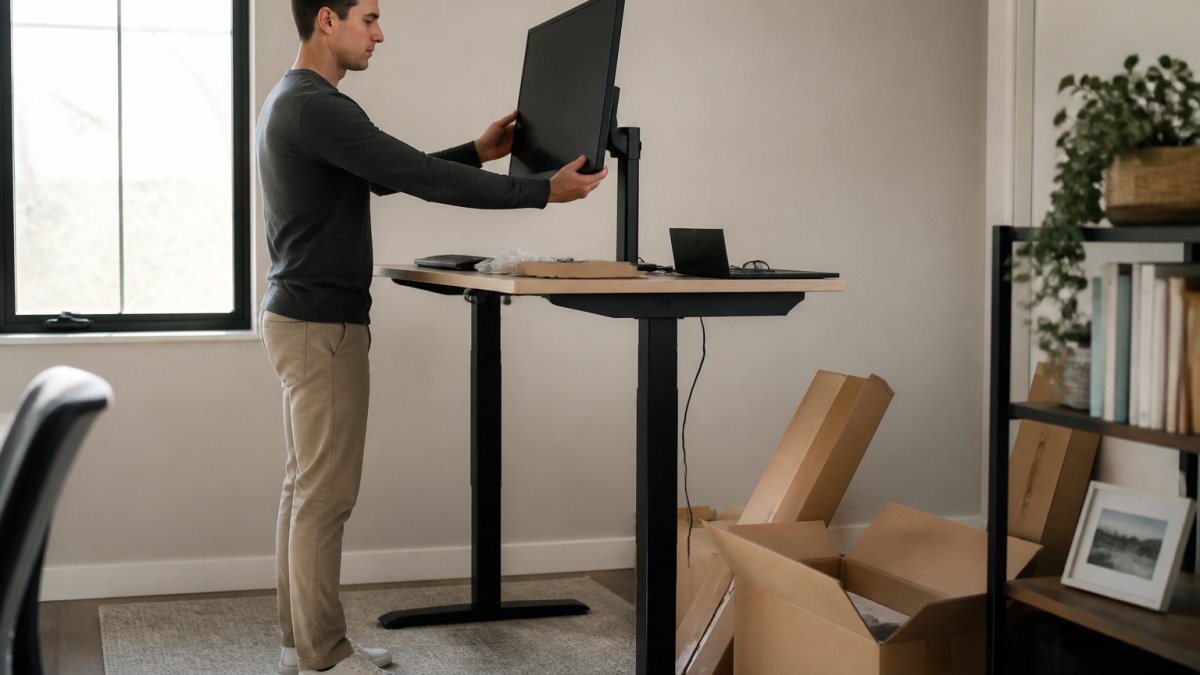
Your monitor should sit directly in front of you at arm's length, with the top of the screen at or slightly below eye level.
Your keyboard and mouse should sit at elbow height, with elbows bent at 90 degrees and wrists neutral.
If you use a laptop, invest in an external keyboard and mouse, laptop keyboards force you to hunch forward because the screen and keyboard are fixed together.
Chair height and lumbar support
Your chair height directly influences your posture.
Lumbar support matters. Your lower back naturally curves inward. A chair that supports this curve keeps your pelvis neutral. This prevents you from slouching forward.
Adjust your chair height first, then your desk to match. If your desk is fixed, adjust the chair and use a footrest if needed.
Movement breaks and posture retraining throughout the day
The best posture is your next posture. Staying in one position, even perfect posture, fatigues your muscles. Stand up every 45-60 minutes.
Use these breaks as posture retraining opportunities. When you stand, notice whether your shoulders feel relaxed and your shoulder blades are positioned properly.
Set a phone reminder if needed. Most people underestimate how often they need to move. Frequent short breaks outperform occasional longer ones.
How Long to Correct Rounded Shoulders: Timeline and Progress
This is the question everyone asks: How long until I see results?
The honest answer depends on how long you've had rounded shoulders, how severe the imbalance is, how consistently you exercise, and how committed you are to ergonomic changes.
Realistic expectations for different causes and abilities
If you've had rounded shoulders for less than six months, you may see noticeable improvement within 4-6 weeks of consistent exercise and ergonomic changes, recent patterns respond quickly.
If you've had rounded shoulders for years, expect 8-12 weeks before significant change.
Some people progress faster than others, younger, regularly active individuals often respond quicker.
Tracking improvement and adjusting your routine
Track your progress with a side-profile photo before you start, then another every two weeks.
Note specific improvements:
- Reduced neck or upper-back tension
- Improved ability to maintain upright posture
- Decreased headaches
If you're not seeing progress after four weeks, reassess: are you doing the exercises correctly, stretching daily, and actually adjusting your workstation?
As you improve, progress your exercises: increase resistance band tension, add repetitions, and increase hold times. Progressive overload ensures continued improvement.
When to Seek Professional Help
Some people need professional guidance to fix rounded shoulders from desk work.
You should also seek help if:
- Your pain is severe or worsening
- You have numbness or tingling in your arms or hands
- Your symptoms are one-sided only
A physical therapist can assess whether your rounded shoulders stem from muscle imbalance, joint restriction, or nerve involvement, then design a personalized program.
We use movement-based assessment to identify root causes, combining the McKenzie Method and the Selective Functional Movement Assessment to understand what's driving your posture and create targeted exercises for your specific situation rather than generic desk-worker advice.
Rounded shoulders from desk work are reversible, and the muscle imbalances that created them can be corrected.
Frequently Asked Questions
How long does it take to fix rounded shoulders from desk work?
Most people notice improved posture and reduced tension within 2-4 weeks of consistent stretching and strengthening. Significant correction of muscle imbalances typically takes 8-12 weeks. Results depend on how long you've had rounded shoulders, your consistency with exercises, and whether you've made ergonomic changes. Chronic cases may require longer or professional guidance to address root causes.
Can stretching alone fix rounded shoulders?
Stretching is essential but incomplete. Rounded shoulders result from both tight chest muscles and weak upper-back muscles. Stretches address tightness, but you also need strengthening exercises to activate your shoulder blades, upper back, and deep cervical flexors. Combining stretches with resistance work and ergonomic adjustments produces the best results.
What's the difference between fixing rounded shoulders yourself and seeing a physical therapist?
Self-directed exercises work well for mild cases and maintenance, but a physical therapist identifies the specific cause of your rounded shoulders using movement assessment. Some cases stem from muscle imbalance, others from structural issues or past injuries. A therapist personalizes your routine, corrects exercise form, and adjusts your plan if you experience pain or plateaus, reducing the risk of wasted effort or injury.
Can I correct years of bad posture from desk work?
Yes. Years of poor posture create strong muscle imbalances and movement habits, but muscle and connective tissue adapt throughout life. Consistent stretching, strengthening, and postural retraining can restore range of motion and shoulder positioning. The longer the habit, the more time and effort required, but significant improvement is achievable with a structured approach and commitment to new movement patterns.