 how-to
Self Management Strategies for Scoliosis That Work
Table of Contents
- Building Your Scoliosis Self Management Plan
- Scoliosis Pain Relief Exercises You Can Do at Home
- Ergonomic Tips for Scoliosis at Work and at Home
- Physical Therapy for Adult Scoliosis: What to Expect
- Daily Habits That Quiet Symptoms
- Movements to Avoid With Scoliosis
- When to Get Help
- Frequently Asked Questions
Last Updated: September 15, 2026
Building Your Scoliosis Self Management Plan
Scoliosis self management strategies for scoliosis work best when built around your curve pattern, daily demands, and pain triggers, not a generic exercise sheet. At Spinal Haven, patients who understand why their symptoms fluctuate stick with their plan far longer than those handed a one-size-fits-all routine.
A workable plan rests on four pillars: a home exercise program, ergonomic adjustments, targeted pain relief, and knowing when to seek professional help.
What a Home Exercise Program Should Include
An effective home exercise program combines three elements: flexibility work for tight structures, strengthening for weak ones, and movement retraining to correct faulty patterns. The [American Physical Therapy(https://spinalhaven.com/event/fuel-and-function-webinar-on-the-benefits-and-potential-for-virtual-physical-therapy/) Association's guide to scoliosis | apta.org] notes that exercise selection should match the curve's location and direction.
Most plans include:
- Daily therapeutic stretching for the spine and hips
- Core stability and scapular stabilization exercises 3-4 times weekly
- Breathing techniques to improve rib mobility
- A short daily routine (10-15 minutes) plus a longer session 2-3 times weekly
The mistake most people make is copying a routine from a video without knowing whether it addresses their curve. A right thoracic curve and a left lumbar curve need different emphasis.
Scoliosis Pain Relief Exercises You Can Do at Home
The most effective scoliosis pain relief exercises are low-impact, controlled, and consistent rather than intense.
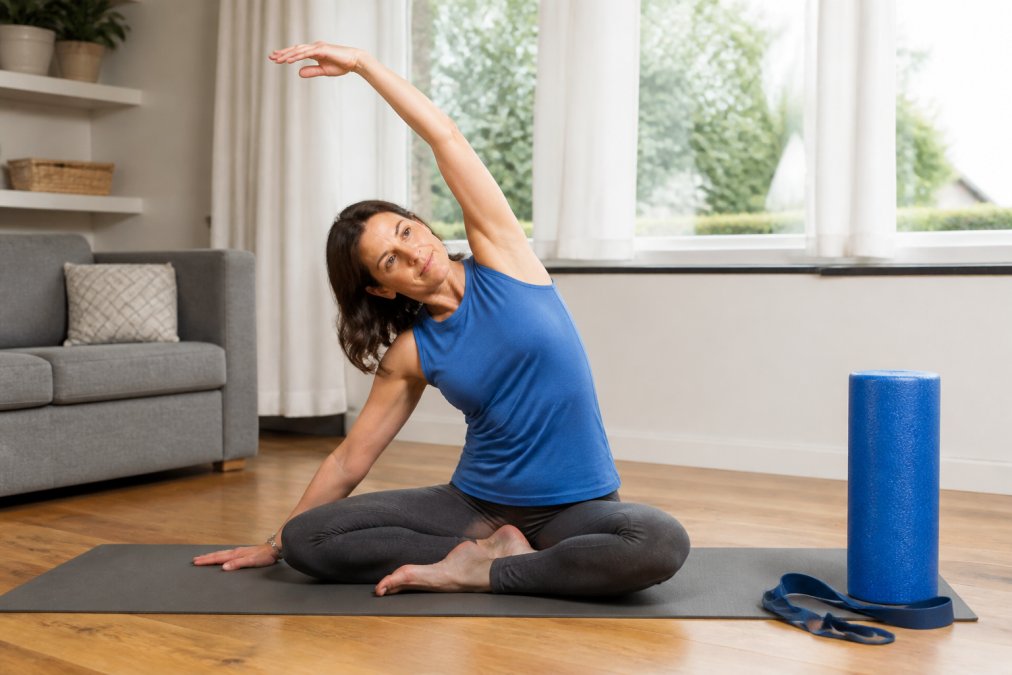
Start with five to ten minutes daily. Stop if pain sharpens.
Therapeutic Stretching for Spinal Flexibility
Therapeutic stretching targets the tight, often concave, side of the curve. Hold each stretch 20-30 seconds, breathe slowly, and never force a position (acsm.org).
A simple starting sequence:
- Cat-cow for spinal mobility
- Side-bend stretch toward the tight side
- Child's pose with a side reach
- Seated spinal twist, gentle and controlled
Core Stability and Scapular Stabilization Work
Core stability protects the vertebral column with muscular support, while scapular stabilization keeps the shoulders and upper back balanced, key for thoracic curves.
Try these three to four times weekly:
- Dead bug (alternating arm and leg extensions)
- Bird dog (opposite arm and leg)
- Side plank from the knees
- Band pull-aparts for scapular control
Ergonomic Tips for Scoliosis at Work and at Home
Ergonomic tips for scoliosis come down to one principle: keep the spine supported in neutral and change position often. No chair fixes a curve, but the wrong setup worsens symptoms.
For desk work:
- Screen top at eye level
- Feet flat, hips slightly above knees
- Lumbar support filling the lower-back curve
- A standing break every 30-45 minutes
At home, the couch is the usual culprit. Slouching into a soft sofa for hours loads one side of the spine. Sit with a cushion behind the lower back, or move to a firm chair.
Postural awareness matters more than any single piece of equipment. The best ergonomic setup is the one you actually adjust throughout the day.
Physical Therapy for Adult Scoliosis: What to Expect
Physical therapy for adult scoliosis focuses on symptom management, function, and education rather than changing the curve itself. A good therapist assesses how you move, not just where the curve sits.
At Spinal Haven, every plan starts with a movement-based assessment. Dr. Elizabeth Kingshott Cary, PT, DPT, Cert. MDT, is certified in the McKenzie Method® and trained in the Selective Functional Movement Assessment (SFMA). These tools are used to find the root cause of pain instead of chasing symptoms. Sessions are one-on-one, in person or virtual, and the goal is to send you home with a plan you can run yourself.
Expect an initial evaluation, a personalized home exercise program, and periodic check-ins. The point isn't endless appointments, it's independence.
Daily Habits That Quiet Symptoms
Small daily habits reduce symptom frequency more than any single exercise. The National Institute of Arthritis and Musculoskeletal and Skin Diseases notes that staying active and maintaining a healthy weight support spine health over time. But the habits that move the needle most are the ones most articles skip: how you manage the mental load of a chronic condition, and how you set up your body for eight hours of recovery every night.
The Psychological Side Nobody Talks About
Living with a curve that shifts with your habits, stress, and sleep is a chronic condition, and chronic conditions carry an emotional load. A common cycle: pain flares, you move less, muscles stiffen, pain worsens, mood drops, and the loop tightens. Breaking it is a self-management skill, not a personality trait.
What helps:
- Name the pattern. A simple symptom log (pain, sleep, stress, activity) for two to three weeks often reveals that flares track stress and poor sleep as much as physical triggers, reducing the helplessness of unpredictable pain.
- Set process goals, not outcome goals. "Do my 15-minute routine five days this week" is controllable. "Get out of pain" is not. Controllable goals protect mood when symptoms fluctuate.
- Protect sleep and movement on bad days. The instinct during a flare is to stop moving entirely, but a short walk or gentle range-of-motion session usually shortens the flare.
- Tell your support network what actually helps. Specific asks ("remind me to do my stretches," "I need you to drive today") reduce the isolation chronic pain creates.
- Know when to bring in a professional. Persistent low mood, anxiety that interferes with daily function, or feeling hopeless about your condition are reasons to talk to a mental health provider. That is a self-management strategy, not a failure of one.
Sleep Positioning and Recovery
Sleep position affects how you feel each morning and is often the highest-leverage habit change available. You spend roughly a third of your life in one position, and one that twists the pelvis or flattens the lumbar curve for eight hours undoes a lot of daytime work.
Back sleeping is the most spine-neutral option. A pillow under the knees takes the arch out of the lower back, and a thin head pillow keeps your chin level rather than tipped forward.
Side sleeping works if you place a pillow between the knees. Without it, the top leg rolls forward, the pelvis rotates, and the lumbar spine twists, the exact load you are trying to avoid during the day. A pillow thick enough to keep hips, knees, and ankles stacked in a straight line is the goal. Side sleepers with a thoracic curve often do better on the side opposite the curve's convexity, but this varies and is worth testing.
Stomach sleeping is hardest on the spine, forcing the neck into rotation and the lumbar spine into extension. If you can't change the habit, a thin pillow under the abdomen reduces the arch, and alternating head rotation limits neck strain. Most people can train themselves to side-sleep within a few weeks using a body pillow behind the back to prevent rolling.
Mattress and pillow mechanics. A supportive mattress matters, but technique matters more, most people wake stiff because of position, not the mattress. Medium-firm is the usual recommendation: soft enough to contour the shoulders and hips, firm enough that the midsection doesn't sink. Replace a mattress with a visible body impression, and choose a cervical pillow that keeps the neck neutral.
The Rest of the Daily Basics
- Walk daily, even 15 minutes.
Movements to Avoid With Scoliosis
Why Some Movements Load the Spine Unevenly
The High-Caution List
Movements to Modify, Not Avoid
Some movements are fine with an adjustment:
Why This List Is Not One-Size-Fits-All
When to Get Help
| Situation | What to Do | Why It Matters |
|---|---|---|
| Mild, stable symptoms | Continue home program | Maintains function |
| Pain limits daily activity | Book an evaluation | Identifies root cause |
| Numbness or weakness | See a doctor promptly | Rules out nerve involvement |
| No progress in 6-8 weeks | Reassess your plan | Wrong plan wastes time |
Frequently Asked Questions
What daily habits help reduce discomfort from scoliosis?
Small routines add up. Set up your workspace so your screen sits at eye level, take a standing or walking break every 30 minutes, and keep one hand free for carrying bags rather than loading one shoulder. Pair that with a short daily stretching routine and consistent sleep positioning. Most people notice the biggest change when they stop treating movement as something that only happens during exercise and start applying body mechanics to ordinary tasks.
Can physical therapy help manage adult scoliosis pain?
Yes. Physical therapy for adult scoliosis focuses on what you can control: muscular imbalance, range of motion, and how you move. A clinician trained in movement assessment can identify which patterns are feeding your symptoms and build a home exercise program around them. The goal is not to straighten the spine but to reduce pain, improve function, and give you tools you can keep using after formal sessions end.
Is walking beneficial for people with scoliosis?
Walking counts as low-impact exercise and supports spine health without loading the vertebral column the way running or heavy lifting can. It also helps with weight management and mood, both of which influence chronic pain management. Start with whatever distance feels comfortable, wear supportive shoes, and pay attention to postural awareness as you go. If walking consistently flares your symptoms, that is a signal to get assessed rather than push through.
What are the do's and don'ts for people with scoliosis?
Do stay active with low-impact movement, keep your core stability work consistent, and adjust your environment instead of fighting it. Don't force end-range twists, do loaded overhead presses through a painful arc, or hold one position for hours. Avoid the mindset that pain means you should stop moving entirely. Activity modification works better than activity avoidance. A qualified professional can tell you which specific movements are contraindicated for your curve pattern.