 How-to
7 Sleep Positions That Help Sciatica Pain Through the Night
Last Updated: October 25, 2026
Quick Summary
Sleep positions sciatica management works best with side sleeping on the opposite side of your painful leg, using a pillow between your knees to keep your spine neutral. Back sleeping with a pillow under your knees also relieves pressure on the sciatic nerve, while stomach sleeping should be avoided entirely as it twists your spine and aggravates pain.
- Side sleeping on the opposite side of your painful leg is the most effective position for most people with sciatica
- Place a pillow between your knees when side sleeping to keep your top knee level with your bottom knee
- Back sleeping requires a pillow under your knees lifted 6 to 8 inches to reduce lower back arch and nerve compression
- Stomach sleeping compresses the sciatic nerve by twisting your spine and should be avoided if you have sciatica
- A medium-firm mattress that supports your spine without sagging works best for managing sciatica pain at night
Table of Contents
- Why Sciatica Worsens at Night and How Sleep Position Matters
- Best Sleeping Position for Sciatica: Side Sleeping With Support
- Back Sleeping With Pillow Placement for Sciatica Relief
- Sleep Positions and Habits That Worsen Sciatica Pain
- How to Relieve Sciatica Pain at Night: Pre-Sleep Routine
- When to See a Doctor for Sciatica: Red Flags and Warning Signs
- Getting Professional Help to Sleep Pain-Free
- Frequently Asked Questions
Why Sciatica Worsens at Night and How Sleep Position Matters
Sleep positions sciatica pain often feels worse at night.
Night pain happens because your body isn't moving.
Your choice of sleep positions sciatica management controls how much pressure sits on that nerve.
Most people assume any comfortable position is the right one.
At Spinal Haven, we help patients with this specific problem. Most have tried random positions with inconsistent results.
Best Sleeping Position for Sciatica: Side Sleeping With Support
Side sleeping is the most effective position for most people with sciatica, but the right side depends on which leg hurts and how you move at night. Use this guide before setting up your bed.
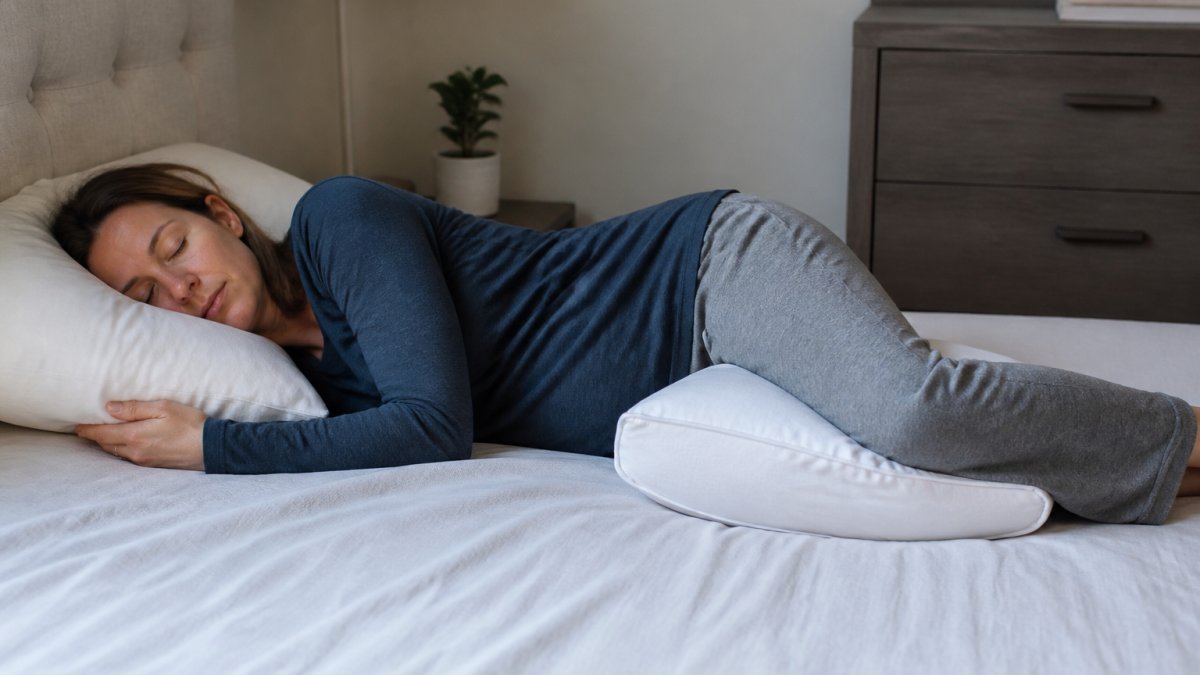
A Simple Decision Guide for Choosing Your Side
If one leg hurts more than the other: Sleep on the side opposite the painful leg.
If both legs hurt or the pain switches sides: Start on your left side, which is often easier on the lower back.
If you move a lot at night: A body pillow keeps your top leg from sliding forward when you shift.
If you're recovering from a flare-up and can't tolerate side lying: Sleep in a recliner or on a couch with knees bent and supported.
Setting Up Your Side-Sleeping Position
Once you have chosen your side, follow these steps in order:
- Lie on your side with hips and shoulders stacked vertically, don't let your top hip roll forward or back.
- Place a pillow between your knees. This is the critical step. It should keep your top knee level with your bottom knee.
- Keep your knees slightly bent, not locked straight, not pulled toward your chest.
- Align your spine so head, shoulders, hips, and ankles form a straight line.
- Use a head pillow that keeps your neck neutral, too high rounds your upper back; too low lets your head drop.
A standard pillow works for most people between the knees. If your knees are bony, a contoured knee pillow or folded towel adds cushioning. A body pillow helps if you need support from knees to ankles or tend to roll forward.
What to Check If Side Sleeping Still Hurts
If side sleeping with a knee pillow doesn't reduce pain within a few nights, check three things:
- Pillow height between the knees. Too thin and your top leg drops, twisting your lower back. Too thick and your top hip tilts up, creating a different twist. The right height keeps your top knee level with your bottom knee.
- Hip position. If your top hip rolls forward toward the mattress, your lower back rotates. Place a small rolled towel behind your back to keep your torso square.
- Mattress sag. A mattress that sags under your hip lets your spine sink into a curve no pillow can fix. A medium-firm mattress that supports your spine without sagging works best for sciatica.
Most people notice relief within a few nights. If a week of consistent setup leaves your night pain unchanged or worse, try back sleeping with knee support or get an assessment, don't force a position that isn't working.
Back Sleeping With Pillow Placement for Sciatica Relief
Back sleeping works if you set it up correctly, most people fail because of wrong pillow placement.
Lie flat on your back with a pillow under your head.
The knee pillow reduces the arch in your lower back.
Pillow height matters: it should lift your knees about 6 to 8 inches off the bed. Knees bent and lower back supported takes pressure off the nerve.
Some combine both: a pillow under the knees plus a thin rolled towel under the lower back.
Back sleeping works best when pain comes from the lower back itself.
Sleep Positions and Habits That Worsen Sciatica Pain
Stomach sleeping is the worst position for sciatica.
Sleeping with your knees straight and legs extended, even on your back, increases lower back arch and nerve compression.
Sleeping curled in a tight ball may feel protective but can aggravate the nerve by twisting your spine.
Twisting your torso while you sleep, even small rotations, puts pressure on the nerve root.
These positions and habits commonly make sciatica worse at night.
| Position or Habit | Why It Worsens Sciatica | What to Do Instead |
|---|---|---|
| Stomach sleeping | Spine twists to one side, compressing the nerve | Avoid entirely if you have sciatica |
| Side sleeping without knee pillow | Spine twists unnaturally without support | Place pillow between knees |
| Back sleeping without knee pillow | Lower back arches, compressing nerve exit | Place pillow under knees, 6-8 inches high |
| Legs extended straight | Increases lower back arch and compression | Bend knees slightly in any position |
| Tight curled ball position | Extreme flexion twists spine | Sleep in gentle curve, not extreme flexion |
| Torso twisting while sleeping | Pressure on nerve root from rotation | Use pillows to prevent rotation |
| Too-soft mattress | Spine sinks into unnatural curve | Use medium-firm mattress |
| Too-firm mattress | Doesn't support natural spine curves | Use medium-firm mattress |
How to Relieve Sciatica Pain at Night: Pre-Sleep Routine
What you do before bed affects your night pain.
Grab a Free Discovery Call Today →
Gentle stretching (5-10 minutes before bed):
Stretching reduces muscle tension that aggravates the nerve. Move slowly and hold each stretch 20-30 seconds:
- Hip flexor stretch: lunge position, back knee on a pillow, lean forward gently
- Glute stretch: lying on your back, pull one knee toward your opposite shoulder
- Hamstring stretch: lying on your back, pull your leg straight up gently with a strap or towel
Avoid aggressive stretching. The goal is to reduce tension, not push into pain. If a stretch hurts, stop.
Heat therapy (15-20 minutes before bed):
Reduce inflammation:
If you take any anti-inflammatory medication, take it before bed so it has time to work while you sleep.
Avoid these habits before bed:
Don't sit for long periods before sleep, sitting increases pressure on the nerve root.
Don't scroll on your phone in bed, it often twists your spine into awkward positions.
Set up your bed before you're tired:
When to See a Doctor for Sciatica: Red Flags and Warning Signs
Most sciatica improves with position changes, stretching, and activity. But some symptoms need urgent medical attention, sometimes the same day. Knowing the difference matters more than any sleep position.
Symptoms That Need Emergency Care
Call 911 or go to an emergency department immediately if you have any of the following:
- Saddle numbness. Numbness or tingling in the area that would touch a saddle, your inner thighs, buttocks, genitals, and the area around your rectum. This is a hallmark of cauda equina syndrome, a rare but serious condition in which the nerve roots at the bottom of the spinal cord are compressed.
- New weakness in one or both legs. If your leg suddenly gives way, you cannot lift your foot, or you cannot stand on your toes or heels, that is new weakness, not the ache of sciatica.
- Loss of bladder or bowel control. Inability to urinate, incontinence, or a sudden change in bowel control, especially combined with saddle numbness, is an emergency.
These signs can indicate nerve damage or a serious condition. Don't wait to see if they improve overnight.
Symptoms That Warrant a Prompt Appointment
See a doctor within a few days, not weeks, if you have:
- Pain that is severe and does not improve with position changes or heat after a week
- Numbness or tingling that spreads down your leg or into your foot
- Pain that follows a fall or injury, even if it seemed minor at the time
When Self-Care Has Stopped Working
Chronic sciatica that doesn't improve with self-care warrants professional help. If two weeks of position changes, stretching, and heat bring no improvement, get an assessment. Evidence-based sciatica physical therapy can identify why sleep positions alone may not be resolving your pain. A physical therapist can identify why, sometimes the issue isn't sleep position but how you move during the day, your posture at work, or underlying weakness.
How to Track Symptoms for Your Clinician
When you see a clinician, bring specifics. A simple log helps:
- Which leg hurts, and where the pain travels (buttock, thigh, calf, foot)
- What time night pain wakes you and how many times per night
- Which positions you tried and whether they helped or made it worse
- Any new symptoms, numbness, weakness, or changes in bladder or bowel habits, and when they started
This log turns a vague "my sciatica is bad at night" into a pattern a clinician can act on. [A comprehensive guide to chronic sciatica management | page:3] can help you decide whether to manage alone or seek assessment.
Getting Professional Help to Sleep Pain-Free
If sciatica keeps you awake despite trying different positions, professional evaluation identifies what's actually causing the pain.
At Spinal Haven, we use a movement-based assessment to find the root cause, not just treat the night pain.
Generic physical therapy gives you stretches.
Most patients gain confidence they can manage their pain without endless appointments or medications.
[Schedule a discovery call with Dr.
Many wait months before getting help, thinking sciatica will resolve on its own.
Frequently Asked Questions
What is the best sleeping position for sciatica?
Side sleeping with a pillow between your knees is generally the most effective position for sciatica relief. This placement keeps your spine in a neutral position and reduces pressure on the sciatic nerve. Back sleeping with a pillow under your knees is the second-best option. Both positions maintain spinal alignment and prevent the twisting that can aggravate nerve irritation. Your individual comfort matters most, try both and see which reduces your night pain.
Where should I put a pillow when sleeping with sciatica?
Pillow placement for sciatica depends on your position. If side sleeping, place a pillow between your knees to keep your hips level and prevent your spine from twisting. If back sleeping, put a pillow under your knees to maintain the natural curve of your lower back. Some people benefit from a body pillow for additional support along the entire side of their body. Avoid placing pillows that push your head too far forward, as this can create tension in your upper back.
When should I seek medical care for sciatica pain?
See a doctor for sciatica if you experience sudden severe pain, numbness in your groin or buttocks, loss of bladder or bowel control, progressive weakness in your leg, or pain that doesn't improve after 2-3 weeks of self-care. Also seek help if pain radiates down both legs or follows an injury. A qualified physical therapist can identify the root cause of your pain and create a personalized treatment plan rather than just managing symptoms.
Can sleeping position make sciatica worse?
Yes. Stomach sleeping, sleeping with your legs straight without support, or sleeping in a twisted position can all aggravate sciatica by putting pressure on the nerve or misaligning your spine. Sleeping on the side with your leg twisted or without knee support can also increase muscle tension and nerve irritation. Avoid positions that require your lower back to arch excessively or your spine to rotate. Consistent poor positioning throughout the night can worsen pain and delay recovery.
Sleep position matters for sciatica, but the right position is only part of the solution. If you've tried different positions and your pain persists, the issue likely goes deeper. A movement assessment identifies what's driving your nerve irritation so you can address it at the source. Get started with a specialized evaluation and learn exactly what your sciatica needs to improve.