 How-to
9 Ways to Manage Back Pain During Long Workdays
Last Updated: November 12, 2026
Quick Summary
Managing back pain workdays means changing position before pain forces you to, ideally standing and walking for two minutes every 30 to 45 minutes. Set up your chair, desk, and screen so your feet stay flat, elbows sit near 90 degrees, and the screen top is at eye level.
- Sitting holds your spine in one position and switches off the deep core muscles that support it.
- When standing, raise the desk so your elbows bend near 90 degrees and shift weight between feet.
- Adjust the chair first, then the desk, then the screen, then your habits.
- Task changes count as breaks because typing, filing, and calls use different muscles.
- Stop the triggering task when pain flares and walk for two to three minutes before sitting again.
Table of Contents
- Why Long Workdays Strain Your Back
- Lower Back Pain From Sitting at a Desk: What Helps First
- Back Pain at Work Standing: Adjustments That Actually Matter
- Ergonomic Tips for Back Pain at Work: A Step-by-Step Setup
- How Often to Take Movement Breaks at Work
- Stretches and Core Work You Can Do Between Meetings
- What to Do When Pain Flares Mid-Shift
- When to Seek Help and How to Book a Discovery Call
- Frequently Asked Questions
Why Long Workdays Strain Your Back
Managing back pain workdays starts with understanding what those long hours actually do to your spine. The World Health Organization reports that low back pain affected 619 million people worldwide in 2020 and estimates cases will reach 843 million by 2050, according to the WHO low back pain fact sheet. At Spinal Haven, we see the same pattern in professionals who sit through meetings, calls, and commutes.
The problem is rarely one dramatic moment. It builds quietly.
The Sitting Trap: What Hours in a Chair Do to Your Spine
Sitting is not rest for your back. A chair holds your spine in one position for hours, and the deep core muscles that support it stop doing their job. Muscle tension collects in the hips and low back. Blood flow slows.
Then the slouch arrives. The head drifts forward, the lower back rounds, and spinal alignment drifts with it. Do that for six hours a day and your body adapts to the shape of the chair.
Standing Isn't a Free Pass
Standing desks help some people, but standing still is its own trap. The International Association for the Study of Pain notes that surveys of manual material-handling workers suggest a one-year prevalence of back pain lasting more than seven days of 25%, per Back Pain in the Workplace. That figure covers lifting-heavy jobs, not office work, so treat it as a warning about load, not a universal number.
The takeaway holds either way: no single position is safe for hours.
Lower Back Pain From Sitting at a Desk: What Helps First
Lower back pain from sitting at a desk usually eases fastest when you change position before you change anything else. Stand up, walk for two minutes, and let the spine move through its full range. Then fix the setup.
Here is the order we recommend:
- Move first. A short walk resets pressure on the discs.
- Check your feet. They should rest flat on the floor.
- Adjust seat depth. Leave a small gap behind your knees.
- Raise the screen. The top of the monitor should sit at eye level.
- Support the low back. A small cushion or the chair's lumbar curve should fill the gap.
If pain keeps returning despite these fixes, a one-on-one assessment can identify what is driving your back pain workdays. Our team offers back pain physical therapy built around your specific movement patterns.
Back Pain at Work Standing: Adjustments That Actually Matter
Back pain at work standing responds to variety, not to a better mat. The goal is to alternate sitting and standing before either position becomes uncomfortable. Most people do well switching roughly every 30 minutes.
Three adjustments make standing work kinder to your spine:
- Raise the desk so your elbows bend near 90 degrees.
- Shift weight between feet instead of locking your knees.
- Wear supportive shoes, not flat dress soles, for long stretches.
Standing all day because "standing is healthier" is a common mistake. It trades one static load for another.
Adjustments for Other Work Styles
Most back-pain advice assumes a desk job. If your workday looks different, the same principle applies, change position before pain forces you to, but the specifics shift.
Driving or commuting. Long drives compress the low back and hold the hips in one angle.
Hybrid work. Switching between a home setup and an office setup is its own trap, because neither chair fits you the same way. Keep a duplicate lumbar cushion and a phone stand in each location so you are not improvising.
Desk-only work. If you rarely stand, the standing desk is less important than the break schedule.
Standing or walking-heavy work. If your job keeps you on your feet, the risk is cumulative load rather than static sitting.
Watch out: a standing desk does not fix a workstation that is set too high or too low. Adjust the desk to your elbows, not your elbows to the desk.
Ergonomic Tips for Back Pain at Work: A Step-by-Step Setup
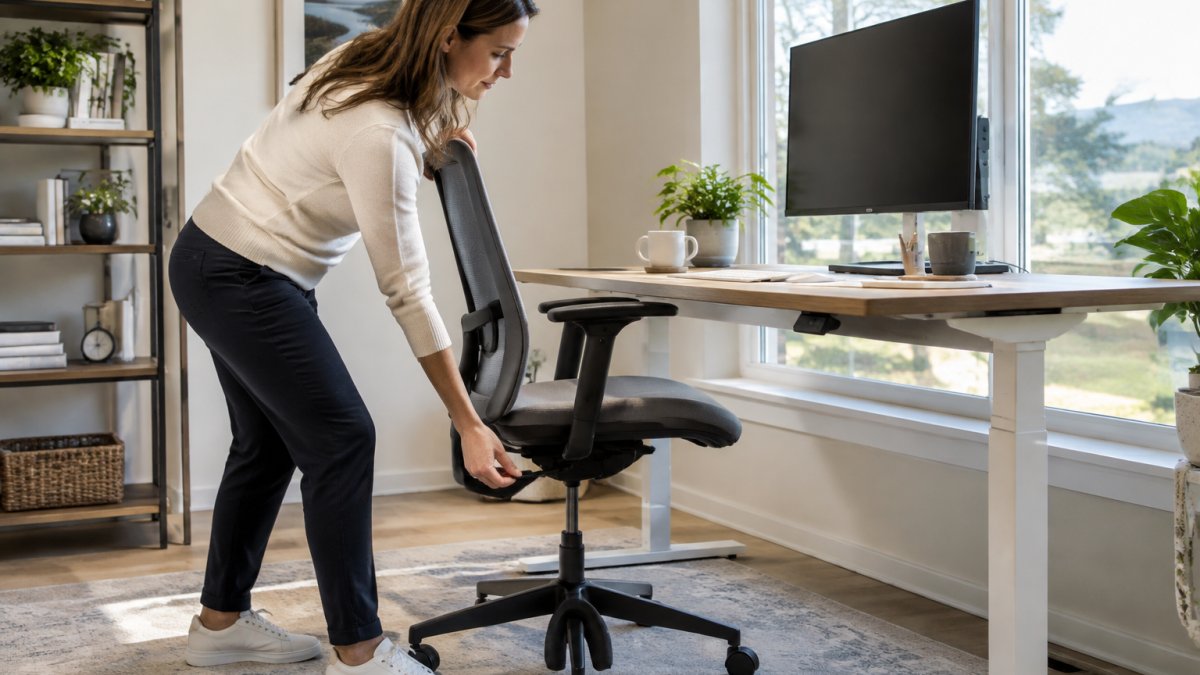
Ergonomic tips for back pain at work work best as a sequence. Adjust the chair first, then the desk, then the screen, then your habits. Changing the screen before the seat wastes the effort.
The Five-Minute Workstation Checklist
Work through this once, then recheck it whenever your setup changes:
- Chair height: feet flat, knees level with hips.
- Seat depth: two fingers of space behind the knees.
- Low back support: curve of the chair fills your lumbar arch.
- Desk height: elbows near 90 degrees, shoulders relaxed.
- Screen position: top of the screen at eye level, an arm's length away.
- Keyboard and mouse: close enough that you do not reach.
- Phone and papers: within easy reach, not behind you.
Rounded shoulders often travel with a poor screen position. Our guide on how to fix rounded shoulders from desk work covers the posture side in more detail.
How Often to Take Movement Breaks at Work
How often to take movement breaks at work depends on your task, but the general guidance is clear. Franciscan Health's workplace advice suggests getting up every 30 to 45 minutes to stretch, refill water, or take a short walk. What most advice leaves out is how to turn that interval into a schedule you can actually follow across a long day.
Use this sample schedule as a template. Adjust the times to your start and end, but keep the pattern of frequent short breaks and one longer movement block.
| Time block | What to do | Why it helps |
|---|---|---|
| First hour (e.g., 8:00-9:00) | Stand and walk 2 minutes at the :30 mark | Breaks up the longest unbroken sitting stretch of the day |
| Mid-morning (9:00-10:30) | Stand every 30-45 minutes; add 5 standing calf raises at your desk | Restores blood flow to the low back and legs |
| Pre-lunch (10:30-12:00) | One 3-minute walk to refill water; switch from typing to a phone call standing up | Changes load on the spine without leaving work |
| Lunch (12:00-1:00) | 10-minute walk after eating | Counters the post-meal slump and stiffness |
| Early afternoon (1:00-3:00) | Stand every 30 minutes; one 2-minute hip flexor stretch | Targets the hip tightness that builds from sitting |
| Mid-afternoon (3:00-4:30) | One longer 5-minute movement break; stand for a call | Prevents the late-day ache that sends people home sore |
| Last hour (4:30-5:30) | Stand for phone calls; switch tasks every 20-30 minutes | Finishes the day without a long static block |
Task changes count as breaks. Moving from typing to filing to a call uses different muscles. The schedule above is a starting point, not a rule. If you lose track of time, set a recurring phone alarm for every 40 minutes and stand for two minutes when it goes off.
Watch out: stacking all your movement into one long break at lunch does not undo six hours of sitting. The value is in the frequency, not the total minutes.
Stretches and Core Work You Can Do Between Meetings
Stretching exercises and core work between meetings keep the spine mobile without a gym trip. Two minutes is enough if you do it often.
Try this short routine:
- Standing extension: hands on hips, gently arch back five times.
- Seated twist: turn your torso each way, hold five seconds.
- Hip flexor stretch: half-kneel, tuck the pelvis, hold 20 seconds per side.
- Chin tucks: draw the head back, hold five seconds, repeat ten times.
- Core brace: tighten the stomach muscles for ten seconds, five rounds.
Core strength matters because those muscles support the spine all day. Our McKenzie Method guide for lower back pain walks through self-treatment movements you can do at your desk.
What to Do When Pain Flares Mid-Shift
When pain flares mid-shift, stop the task that triggered it and change position. Do not push through a sharp pain to finish an email. Most flares settle with movement, but some need care.
A step-by-step response:
- Stand and walk for two to three minutes.
- Try one gentle extension movement.
- Adjust your seat or screen before sitting again.
- Switch to a task that lets you change position.
- Note what triggered the flare for your next visit.
Watch out: numbness, weakness, or pain that shoots down the leg and does not ease deserves prompt medical attention. Those signs need a clinician, not a stretch.
If flares keep returning, read our guide on managing chronic back pain without surgery for the longer view.
When to Seek Help and How to Book a Discovery Call
Seek help when pain lasts more than a few weeks, keeps you from work, or comes with numbness or weakness. A systematic review in PMC found sustainable return-to-work rates of 22% to 62% after two years for people with chronic occupational back pain, per the return-to-work review.
At Spinal Haven, Dr. Elizabeth Kingshott Cary, PT, DPT, Cert. MDT, uses the McKenzie Method® and the Selective Functional Movement Assessment (SFMA) to identify the root cause of pain rather than just treating symptoms. Sessions are one-on-one, and the focus is on teaching you to manage movement with confidence.
You can book a discovery call to see whether this approach fits your situation.
Long workdays will keep testing your back. The difference is whether you have a plan for them. Spinal Haven offers one-on-one care, movement-based assessment, and self-management tools so you can return to work, fitness, and family life without pain. Get started with Spinal Haven and build a workday your back can handle.
Frequently Asked Questions
How often should I get up and move when I have back pain at work?
A practical starting point is every 30 to 45 minutes, even if the break is only 60 seconds of standing, walking to fill a water bottle, or a gentle stretch. Franciscan Health recommends getting up every 30 to 45 minutes for stretching, water, or a short walk. The exact interval matters less than consistency; setting a recurring calendar reminder for the first two weeks helps the habit stick. If your back pain workdays tend to flare in the afternoon, add one longer five-minute walk after lunch.
Can standing all day cause back pain?
Yes. Standing still for long stretches loads the lower back and legs much like sitting does, just in a different position. The fix is not to abandon standing but to alternate: shift weight, use an anti-fatigue mat, and change posture every 20 to 30 minutes. If you use a standing desk, build up gradually rather than switching from all-sitting to all-standing in one week. Persistent back pain at work standing that does not ease with position changes is worth a professional assessment.
How many days of rest are recommended for lower back pain?
For most uncomplicated lower back pain, prolonged bed rest is no longer recommended. Short rest during the first day or two is fine, but returning to gentle movement and normal activity as tolerated usually helps recovery. If pain is severe, worsening, or accompanied by numbness, weakness, or loss of bladder or bowel control, seek medical care promptly. A physical therapist can help you decide what activity level is appropriate for your specific situation.
When should I seek professional help for back pain at work?
Seek help if pain lasts more than a few weeks, keeps returning, or limits your ability to sit, stand, or lift at work. Also seek care sooner for numbness, tingling, weakness in a leg, or pain that follows a fall or injury. A one-on-one evaluation can identify the root cause rather than just treating symptoms. Spinal Haven offers in-person and virtual care, and a discovery call is a low-pressure way to ask whether their approach fits your situation.