 Listicle
7 Best Core Exercises for Desk Workers
Last Updated: November 3, 2026
Quick Summary
The best core exercises for desk workers are seated leg raises, seated oblique twists, desk planks, chair squats, wall sits, and glute bridges. These moves need only a chair, desk, or wall, so you can train your core without leaving your workspace. Start with 5 minutes of seated core work daily, split into two or three breaks.
- Seated options score highest on privacy, while floor options score highest on core demand.
- Do 2 sets of 10 to 12 seated leg raises, holding each contraction for 2 seconds.
- Hold a desk plank for 15 to 30 seconds, and test the desk's stability first.
- Add 2 repetitions or 5 seconds of hold time each week, not more.
- Add chair squats, wall sits, and glute bridges three days per week.
Table of Contents
- Why Desk Workers Need Core Exercises
- How We Ranked These Core Exercises for Desk Workers
- 1. Seated Leg Raise and Reverse Crunch
- 2. Seated Oblique Twist and Oblique Squeeze
- 3. Desk Plank and Push-Up
- 4. Chair Squat and Wall Sit
- 5. Glute Bridge and Floor-Based Core Work
- 6. Exercises for Lower Back Pain From Sitting
- Frequently Asked Questions
Why Desk Workers Need Core Exercises
Sitting for long stretches weakens the muscles that support your spine. Active adults who exercise regularly can still develop back stiffness when their core spends most of the workday switched off. The core is the ring of muscle around your trunk, including the abdominals and obliques, that stabilizes the spine during everyday movement.
The good news is that you do not need a gym to train it. NASA's Deskfit booklet lays out 20 exercises you can do without leaving an office or home, which shows how much can be done in the space you already occupy.
Below, we rank the best core exercises for desk workers, with step-by-step instructions, modifications for different ability levels, and a weekly plan you can start this week. If sitting has also left you with rounded shoulders, our guide on how to fix rounded shoulders from desk work pairs well with the routine here.
How We Ranked These Core Exercises for Desk Workers
We ranked each movement on four factors: equipment needed, how discreet it is in a shared office or on a video call, how directly it loads the core, and how easily it can be modified for back pain or limited mobility. Seated options scored highest on privacy. Floor options scored highest on core demand. Standing options fell in the middle on both, which makes them the most versatile choice when your workday shifts between a cubicle, a conference room, and a home desk.
A common mistake is chasing the hardest move first. In practice, the exercise you can repeat three times a day beats the one you attempt once and abandon. The table below separates movements by setting so you can pick the right option for the room you are actually in.
| Exercise | Setting | Equipment | Privacy | Core Demand | Best For |
|---|---|---|---|---|---|
| Seated leg raise | Seated | Chair | High | Moderate | Private cubicle or closed office |
| Seated oblique twist | Seated | Chair | High | Moderate | Side and waist strength during calls |
| Desk plank and push-up | Standing | Desk | Medium | High | Upper body plus core in a private office |
| Chair squat and wall sit | Standing | Chair or wall | Medium | Moderate | Legs and trunk together between meetings |
| Glute bridge | Floor | Mat or floor | Low | Moderate | Lower back support at home or in a private room |
| Floor plank | Floor | Mat or floor | Low | High | Highest core demand when privacy allows |
If stiffness and weakness go beyond what exercise alone can address, our mobility and movement restoration service is built for exactly that.
1. Seated Leg Raise and Reverse Crunch
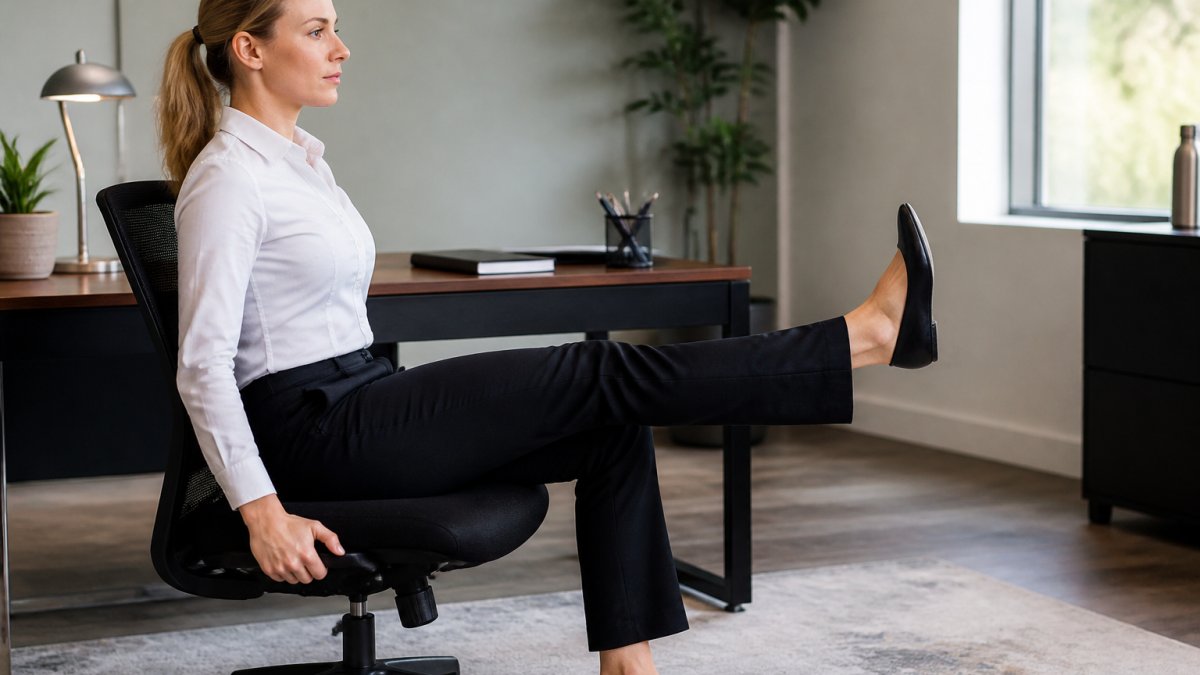
This is the most practical starting point for anyone in an open office. The seated leg raise trains hip flexion and lower abdominal control without leaving your chair. Core training is commonly linked to better balance, spinal stability, and hip mobility, which is what this movement targets.
How to Do It
- Sit tall with feet flat on the floor and hands gripping the seat edges.
- Lean back slightly and lift both knees toward your chest, then lower with control.
- For the reverse crunch, lift one knee at a time and curl your pelvis gently.
- Do 2 sets of 10 to 12 repetitions, holding each contraction for 2 seconds.
Keep the movement slow. Rushing turns a core exercise into a momentum exercise, and momentum is where backs get irritated.
2. Seated Oblique Twist and Oblique Squeeze
Your obliques handle rotation and side-bending, and they are the muscles most neglected by desk workers who only train the front of the body. The seated oblique twist is a rotation drill you can do mid-call.
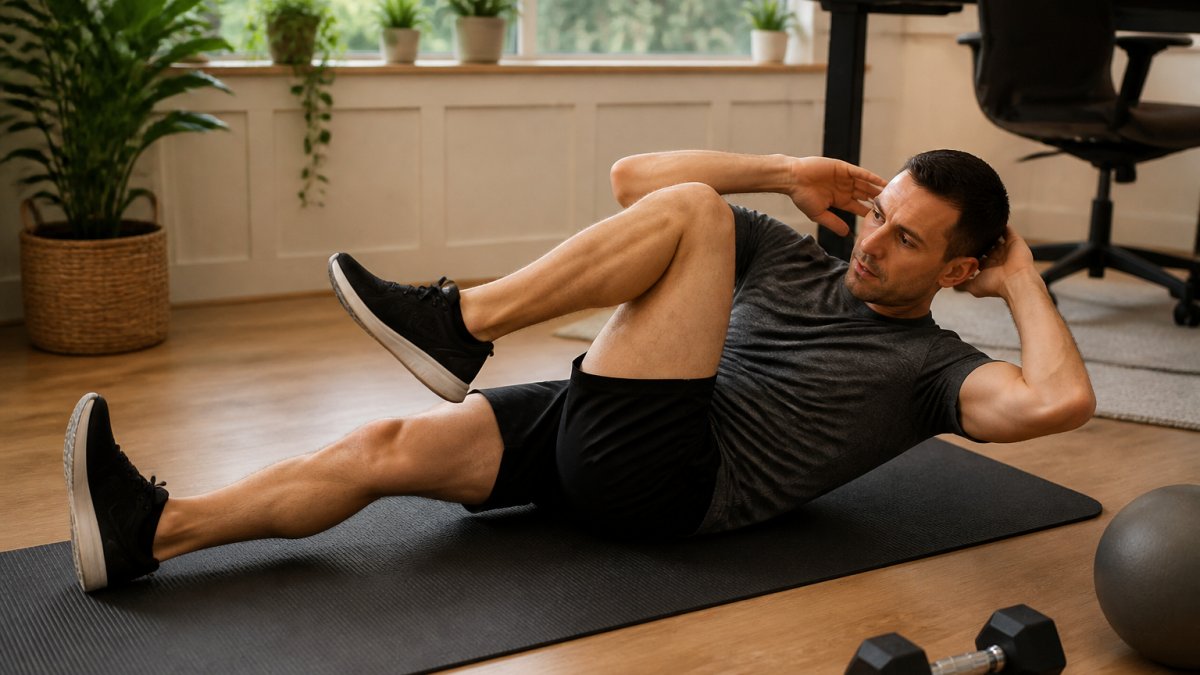
Sit upright, place your hands behind your head or across your chest, and rotate your torso slowly to one side, then the other. For the oblique squeeze, stay rotated and hold for 3 to 5 seconds before switching. Do 8 to 10 rotations per side.
Watch out: twisting fast and far is the most common form error. Rotate only as far as feels comfortable, and stop if you feel a sharp catch in the lower back.
3. Desk Plank and Push-Up
The desk plank turns your workstation into a stability tool. Cleveland Clinic's desk exercise guidance describes desk planks and push-ups as moves that work the core and upper body together, which is efficient for anyone short on time.
Grab a Free Discovery Call Today →
Place both hands on the edge of a sturdy desk, walk your feet back until your body forms a straight line, and hold for 15 to 30 seconds. For the push-up, bend your elbows to lower your chest toward the desk, then press back up. Do 2 to 3 sets.
Watch out: a desk that rolls or a chair that slides will make this unsafe. Test the desk's stability with your full weight before you start.
4. Chair Squat and Wall Sit
These two standing exercises train the legs and trunk as one unit, which matters because a strong core is only useful if the hips and legs support it. Stand in front of your chair, hinge at the hips, and lower until you lightly touch the seat, then stand. That is a chair squat: 10 to 15 repetitions.
For the wall sit, slide your back down a wall until your thighs are parallel to the floor and hold for 20 to 30 seconds. Both moves count as isometric strengthening, where the muscle works without changing length.
5. Glute Bridge and Floor-Based Core Work
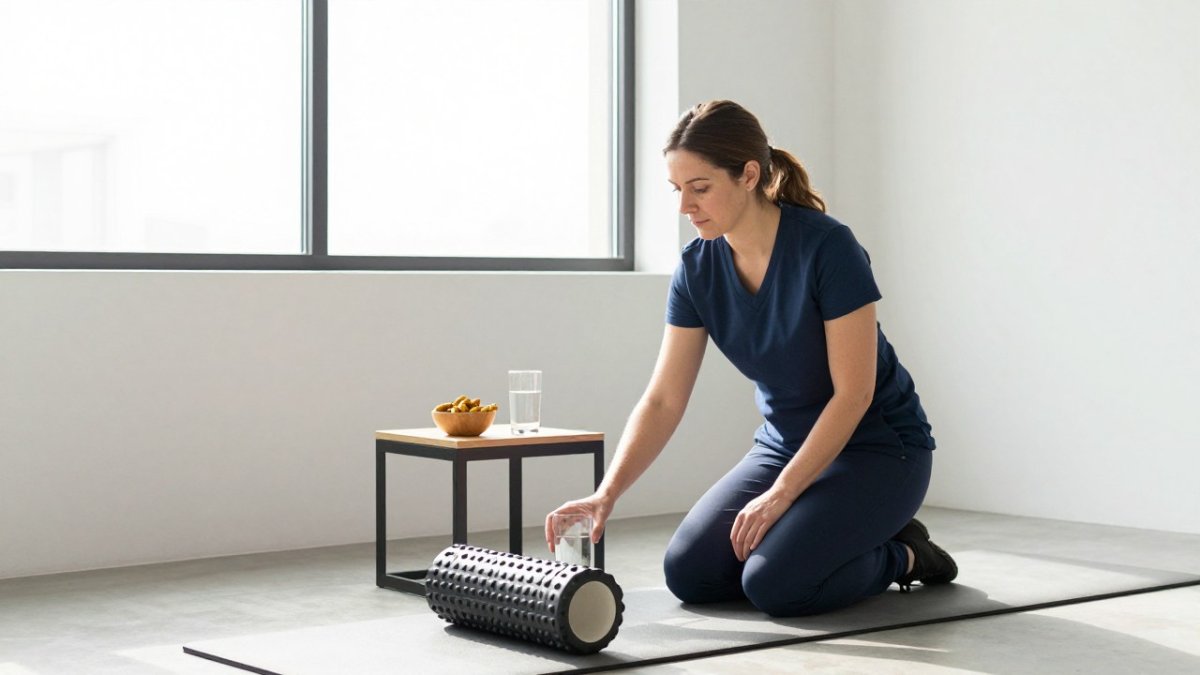
Floor exercises give you the most control over load, which makes them the best choice for a home office or a private room. Lie on your back with knees bent, press through your heels, and lift your hips until your body forms a straight line from shoulders to knees. Hold for 2 seconds at the top and lower slowly. Do 2 sets of 12.
From the same position, add a leg extension or a leg pull-in to increase the demand on the abdominal muscles. A plank on the floor, held for 20 to 40 seconds, rounds out the set. If you have a mat and a quiet space, this is the highest-value block in the routine.
6. Exercises for Lower Back Pain From Sitting
Lower back pain from sitting usually responds best to gentle, frequent movement rather than one long session. Start with the seated leg raise and oblique squeeze, add a short walk every hour, and progress to floor work only when the seated moves feel easy.
A practical weekly plan looks like this:
- Daily: 5 minutes of seated core work, split into two or three breaks.
- Three days per week: add chair squats, wall sits, and glute bridges.
- Progress: add 2 repetitions or 5 seconds of hold time each week, not more.
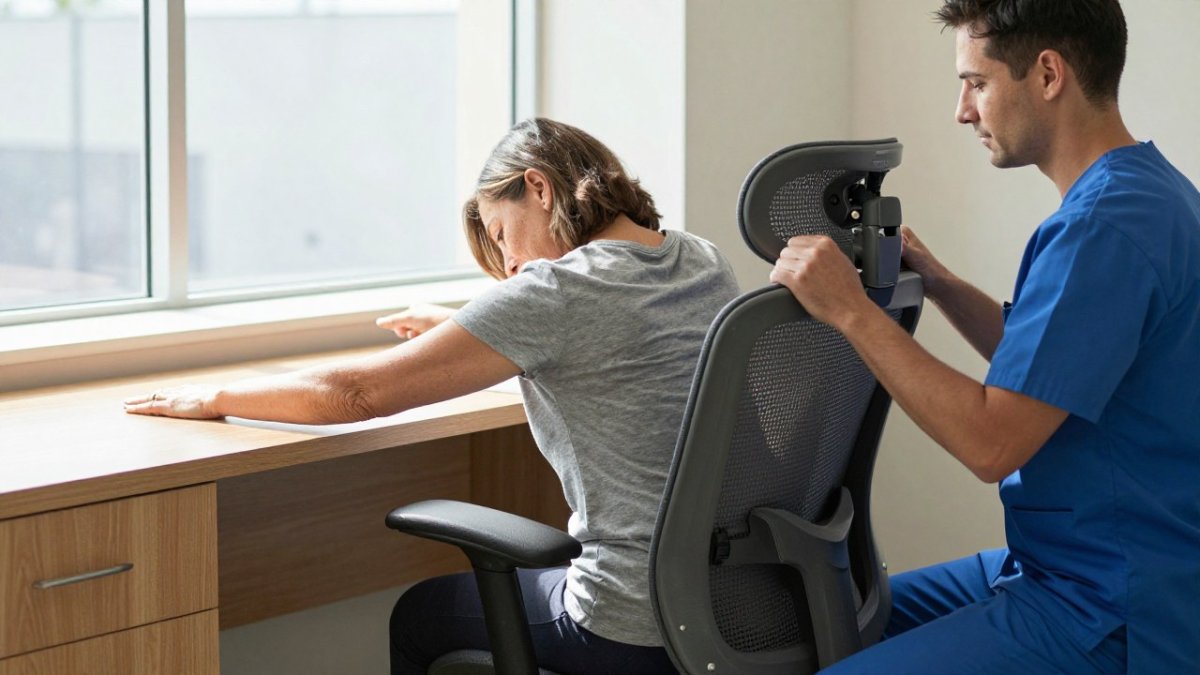
If pain persists despite consistent exercise, or if it travels down the leg, that is a signal to get assessed rather than push through. Spinal Haven offers one-on-one physical therapy evaluation for back pain. The McKenzie Method® approach used at Spinal Haven focuses on patient education and long-term self-management. And when you are ready to talk it through, you can schedule your one-on-one evaluation with Dr. Elizabeth Kingshott Cary.
The exercises above are a starting point, not a diagnosis. If your back pain has outlasted a few weeks of consistent movement, the missing piece is usually an assessment that identifies what is actually driving your symptoms. At Spinal Haven, we combine the McKenzie Method® and the Selective Functional Movement Assessment to identify the root cause of pain, then build a personalized plan. You get one-on-one sessions, in person or virtual, and tools to manage your movement with confidence. Book a discovery call with Spinal Haven to talk through your situation.
Frequently Asked Questions
Can you strengthen your core while sitting at a desk?
Yes. Seated moves such as the seated leg raise, reverse crunch, and oblique twist recruit the abdominal muscles and obliques while you stay in your chair. Desk-based exercise programs show how much work fits into a workday. Seated core exercises build endurance for holding posture, though standing and floor options still belong in a complete routine.
How often should desk workers perform core exercises?
Aim for three to four short sessions per week, with a workday movement break every hour or so. Keep sets to two or three and reps to 8-12 per move, holding isometric positions like the desk plank for 15-30 seconds. Consistency generally matters more than session length when building core strength.
Are there discreet core exercises I can do during a meeting?
Several. The oblique squeeze, seated leg extension, and glute squeeze involve almost no visible movement and need no equipment beyond your office chair. Sit up straight with feet flat on the floor, contract for five seconds, and release. These low-profile isometric strengthening moves fit into calls and video meetings, while the seated leg raise and desk plank work better between tasks.
How does core strength impact posture for desk-bound professionals?
The abdominal muscles, obliques, and lower back muscles work together to hold the spine in alignment, so a stronger core makes it easier to sit up straight for longer stretches. Poor core stability often shows up as slumping and increased strain on the lower back by mid-afternoon. Pairing core exercises with an ergonomic setup and hourly movement breaks gives you the best shot at lasting posture change.
What if core exercises make my back pain worse?
Stop the move and note which position triggered the symptoms, since that pattern is useful information. Some desk workers with lower back pain do better starting with deep-core activation and breathing rather than sit-ups, and a clinician can tell you which movements suit your situation. If pain persists, worsens, or travels down a leg, book an assessment with a qualified physical therapist before continuing.