 Listicle
How to Choose the Best Office Chair for Rounded Shoulders
Last Updated: November 8, 2026
Quick Summary
The best office chair for rounded shoulders has a narrower backrest that lets your shoulder blades move freely while supporting your lower back in a neutral position. Set the armrests so your shoulders stay down and your elbows sit near 90 degrees, and pair the chair with a properly arranged desk and monitor.
- A chair cannot reverse rounded shoulders; a well-fitted chair can stop feeding the pattern.
- WIRED named the Branch Ergonomic Chair Pro its favorite for most people in its 2026 roundup.
- Look for a backrest narrow enough to clear your shoulder blades during upright work.
- Seat depth should leave two to three fingers of space behind your knee.
- Stand and reset every 30 to 45 minutes, even briefly, to interrupt upper-back drift.
Table of Contents
- Why the Best Office Chair for Rounded Shoulders Starts With Fit, Not Features
- Quick Comparison: Top Chairs for Rounded Shoulders
- Key Features That Make a Chair the Best for Posture Correction
- Why an Office Chair With Adjustable Armrests Helps Relax Your Shoulders
- How to Fix Rounded Shoulders From Desk Work: A Combined Chair and Workstation Plan
- How to Assess Whether a Chair Fits Your Shoulders
- Chair Recommendations by Body Type and Use Case
- When a Chair Is Not Enough: Next Steps With Spinal Haven
- Frequently Asked Questions
Why the Best Office Chair for Rounded Shoulders Starts With Fit, Not Features
Rounded shoulders develop when the upper back and shoulder blades settle into a forward position, usually after months of hunching over a keyboard. A chair cannot reverse that pattern. What a well-fitted chair can do is stop feeding it.
That distinction matters, because the search for the best office chair for rounded shoulders is crowded with claims no chair can honestly make. A chair alone rarely resolves the posture pattern behind rounded shoulders, and adjusting one is often overlooked.
WIRED tested 70 office chairs for its 2026 roundup and named the Branch Ergonomic Chair Pro its favorite for most people at $499, while CNN Underscored's 2026 chair testing compared 18 popular models on comfort, adjustability, and ease of use. Both outlets judge chairs on adjustability and fit. Neither claims a chair corrects posture, and that is the right frame.
Here is the practical version: fit first, features second, and a workstation plan alongside both.
Quick Comparison: Top Chairs for Rounded Shoulders
No single chair wins for every body, but a focused comparison against shoulder-fit criteria can narrow the field fast. The table below ranks chairs by how well they support an upright upper back while leaving the shoulder blades free to move, the combination that matters most for rounded shoulders.
| Rank | Chair | Price | Backrest Style | Shoulder-Fit Notes | Best For | Watch Out For |
|---|---|---|---|---|---|---|
| 1 | Branch Ergonomic Chair Pro | $499 | Mid-back, adjustable lumbar | Narrow enough for most frames to clear shoulder blades; armrests adjust in height and width | Most desk workers wanting a proven all-rounder with strong shoulder clearance | Limited shoulder-blade relief if you sit very tall |
| 2 | Branch Verve | Varies by retailer | Curved, supportive | Firmer backrest encourages upright posture; armrests adjust but width range is moderate | All-day comfort with a firmer feel and good shoulder relaxation | Firmness is not for everyone; shorter users may find seat depth too deep |
| 3 | Mesh-back task chairs (e.g., mid-range ergonomic models) | Varies | Breathable mesh, often narrow | Mesh flexes with shoulder movement; look for adjustable lumbar and armrests | Warm offices, shoulder mobility, and users who shift position often | Cheaper mesh sags within a year; backrest height varies widely |
| 4 | High-back executive chairs | Varies | Wide, padded, headrest | Wide backrests can block shoulder-blade movement; headrest useful only when reclining | Upper-back and neck support for users who recline frequently | Wide backrests push shoulders forward during upright work |
| 5 | Stool or saddle seat | Varies | Minimal | No backrest to interfere with shoulder movement, but no lumbar support either | Short bursts of active sitting | Not built for eight-hour days; may worsen rounding without frequent breaks |
Chair pricing varies, and the model that fits your torso matters more than the price tag. For a deeper look at how we assessed shoulder clearance, see the fit-check section below.
Key Features That Make a Chair the Best for Posture Correction
The best chair for posture correction is one that holds your pelvis and lower back in a neutral position while leaving your shoulder blades free to move.
Start with lumbar support. The curve should meet your lower back without pushing you forward. If the lumbar pad forces your ribs ahead of your hips, you will round your upper back to compensate, which is the opposite of what you wanted.
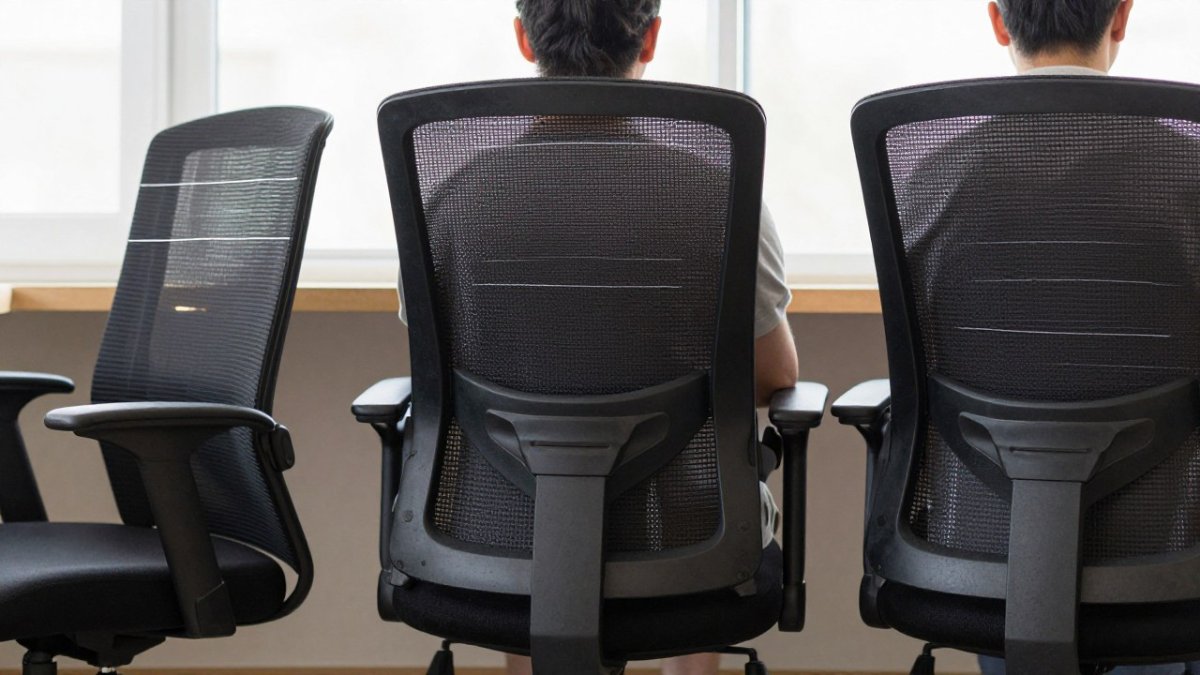
Then look at backrest shape. Guidance from Anthros on shoulder pain and chair design recommends considering a narrower backrest that lets the shoulder blades move freely. A wide, tall backrest feels supportive in the showroom and restricts your shoulders by mid-afternoon.
Seat height and depth decide whether your feet rest flat and your knees sit near hip height. When the seat is too deep, you slide forward and lose the backrest entirely.
- Lumbar support that matches your curve, not the average curve
- A backrest narrow enough to clear your shoulder blades
- Seat depth that leaves two to three fingers behind your knee
- Adjustable armrests that let your shoulders drop
- A headrest only if you recline, not for upright work
Why an Office Chair With Adjustable Armrests Helps Relax Your Shoulders
An office chair with adjustable armrests does one specific job: it takes the weight of your arms off your neck and upper traps. When armrests sit too high, your shoulders ride up toward your ears all day. Too low, and you slump to reach them.
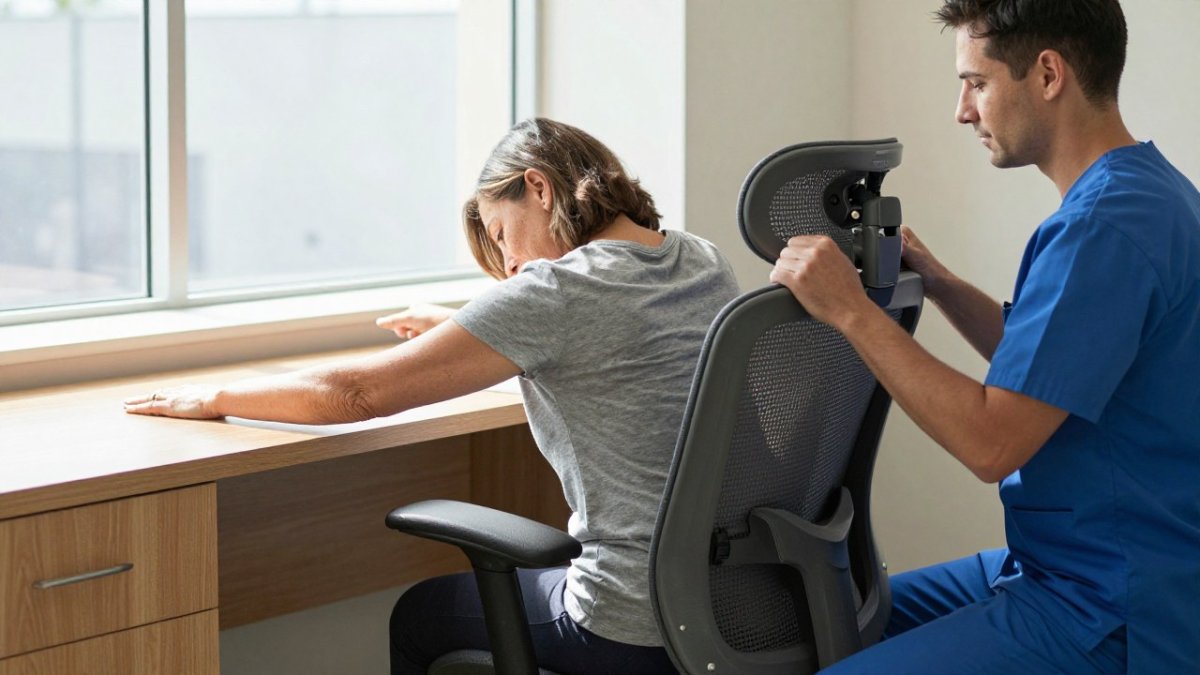
Set the armrests so your forearms rest at roughly desk height with your shoulders down and relaxed. Your elbows should land near 90 degrees. If you have to lift your shoulders even slightly to type, the armrests are wrong for you.
What most buyers miss is that armrest height is only half the setting. Width matters too. Armrests set too wide pull your shoulders into a rounded position, which is exactly the pattern you are trying to interrupt. Bring them in until your upper arms hang close to your ribs.
How to Fix Rounded Shoulders From Desk Work: A Combined Chair and Workstation Plan
Knowing how to fix rounded shoulders from desk work means treating the chair and the desk as one system. A perfect chair at a badly arranged desk still produces the same hunch.
Set the chair first, then the desk, then the screen. This order prevents the common mistake of adjusting your chair to fit a monitor that is in the wrong place.
- Set seat height so your feet rest flat and knees sit near hip height.
- Set seat depth so your back meets the lumbar support without sliding forward.
- Set armrests so shoulders stay down and elbows sit near 90 degrees.
- Raise the monitor so the top line sits at or slightly below eye level.
- Bring the keyboard close enough that your elbows stay near your sides.
- Stand and reset every 30 to 45 minutes, even briefly.
The last step is the one people skip. Prolonged sitting in any chair, however well fitted, lets the upper back drift forward. Brief standing breaks interrupt that drift more reliably than any cushion.
How to Assess Whether a Chair Fits Your Shoulders
A chair fits your shoulders when your shoulder blades can move against the backrest without being pushed forward. Test that in the store or at home before you commit.
Sit all the way back. Roll your shoulders gently. If the backrest catches your shoulder blades and pushes them forward, the backrest is too wide or too tall for your frame. If your shoulders move freely while your lower back stays supported, the shape is right.
Then check three quick measurements:
- Seat depth: two to three fingers of space behind your knee.
- Backrest height: the top edge should sit below your shoulder blades for upright work.
- Armrest width: upper arms hanging close to your ribs, not pushed outward.
Taller frames often need a higher backrest and a deeper seat. Shorter frames usually need the opposite, and many standard chairs simply do not adjust far enough.
Chair Recommendations by Body Type and Use Case
Body type changes the recommendation more than brand loyalty does. A chair that fits a 6-foot-2 frame will push a 5-foot-4 user forward all day.
For taller users (over 6 feet), prioritize seat depth and backrest height. Look for a seat depth that adjusts across a usable range and a lumbar pad that can be positioned vertically, not just in and out. Watch out: many high-back executive chairs have a fixed backrest that hits tall users at the shoulder blades, pushing them forward.
For shorter users (under 5-foot-6), seat depth is the limiting factor.
For heavier users, check the chair's weight rating and the firmness of the seat foam. Soft foam compresses quickly and drops you below the lumbar curve. Verify the manufacturer's weight limit before buying any chair.
For mixed home and office use, a chair with straightforward, marked adjustments beats a complex one. You will actually reset it when you move between spaces.
For users who recline frequently, a headrest becomes useful, but only if it supports the neck without pushing the head forward.
When a Chair Is Not Enough: Next Steps With Spinal Haven
Some rounded shoulders need more than equipment.
That is where we come in. Our Selective Functional Movement Assessment (SFMA) is a systematic screen that traces symptoms back to their source, and our mobility and movement restoration work rebuilds the stiffness and weakness that keep pulling you forward.
For readers dealing with desk-related neck tightness and headaches, our neck pain physical therapy targets those symptoms directly. Dr. Elizabeth Kingshott Cary, PT, DPT, Cert.
If you want to know whether this approach fits your situation, schedule your one-on-one evaluation and we will walk through it together.
A chair is a tool, not a cure. Choose one that fits your shoulders, set up your desk around it, and move often enough to interrupt the pattern.
Get started with Spinal Haven and build a plan that addresses the cause, not just the symptom.
Frequently Asked Questions
Can an office chair correct rounded shoulders?
No chair can correct rounded shoulders on its own. A well-designed, properly adjusted chair is one workstation element that supports upright posture and reduces hunching, but the research does not show that any chair reverses the shape of your shoulders. The best office chair for rounded shoulders removes barriers to good posture, such as a backrest that pushes your shoulder blades forward or armrests that force you to reach. Pairing the chair with a sensible desk setup and targeted movement work gives you the best chance of lasting change.
What features should I look for in an office chair for rounded shoulders?
Focus on a backrest that leaves your shoulder blades free to move, ideally a narrow or contoured design. Adjustable armrests that let your shoulders relax instead of reaching are important, along with adjustable seat height and depth so your feet rest flat and your back stays supported. A headrest can help with forward-head posture, and lumbar support keeps your lower back aligned. Consumer testing outlets generally evaluate chairs on comfort, adjustability, and ease of use.
How should I adjust my office chair to avoid hunching?
Set seat height so your feet sit flat and your knees are near hip level, then adjust seat depth so your back reaches the lumbar support without a gap. Lower the armrests until your shoulders drop and your elbows rest near 90 degrees, and raise your monitor so the top of the screen is at or slightly below eye level. Keep your keyboard within easy reach to avoid leaning forward. If you still find yourself hunching after these adjustments, the chair's backrest shape may not suit your shoulders, and a different fit is worth testing.
Are armrests helpful or harmful for rounded shoulders?
Armrests help when they let your shoulders relax and your elbows rest at roughly 90 degrees, which reduces the reaching and rounding that builds up over a long day. They become harmful when they are too high, pushing your shoulders up toward your ears, or too far forward, pulling you into a forward-shoulders position. An office chair with adjustable armrests lets you dial in height, width, and angle so the armrests support your arms instead of dictating your posture. Test each setting while sitting tall and notice whether your shoulders drop.