 How-to
Improve Functional Movement Patterns: A Step-by-Step Guide
Last Updated: November 4, 2026
Quick Summary
To improve functional movement, self-assess the seven core patterns (squat, hinge, lunge, push, pull, rotate, carry), then train the specific pattern that failed with corrective exercises before adding load. Full-body resistance training two to three days per week, paired with mobility work, builds smooth, pain-free patterns.
- Screen yourself with an overhead squat, hip hinge, and 20-second single-leg balance test.
- Corrective training two sessions per week for six weeks improved movement quality in a 2024 study.
- Move up one exercise level only after two weeks of clean, pain-free reps.
- Train all three planes of motion: sagittal, frontal, and transverse.
- Stand and do 10 slow squats every hour to counter desk-work stiffness.
Table of Contents
- What Functional Movement Patterns Are and Why They Matter
- Step 1: Self-Assess Your Movement Before You Train
- Step 2: Build Corrective Exercises for Movement Limitations
- Step 3: Train the Squat, Hinge, Push, Pull, and Carry
- Improving Mobility for Desk Workers Without Losing Strength
- How Functional Movement Patterns Physical Therapy Finds the Root Cause
- Common Mistakes That Stall Movement Quality
- Book a Discovery Call at Spinal Haven
- Frequently Asked Questions
What Functional Movement Patterns Are and Why They Matter
Functional movement patterns are the basic motions your body uses in daily life, such as squatting, bending, pushing, pulling, and carrying. Research shows that an 8-week functional training program outperforms traditional training for improving how well you move (study in Frontiers in Public Health). At Spinal Haven, we see the same thing in the clinic: people who train whole movement patterns recover better than people who only stretch one sore spot. Below, we break down the patterns, how to check your own movement, and how to build it back safely.
The Seven Patterns Your Body Runs On
Most of us move through seven patterns every day, whether we notice or not:
- Squat: standing up from a chair, getting out of a car
- Hinge: bending to pick something up, lifting a bag
- Lunge: climbing stairs, stepping forward
- Push: opening a heavy door, pressing up from the floor
- Pull: pulling a door toward you, rowing
- Rotate: turning to look behind you, twisting to reach a seatbelt
- Carry: holding groceries, a briefcase, or a child
When one pattern gets weak or stiff, the others pick up the slack. That is where nagging back and neck pain often starts.
Step 1: Self-Assess Your Movement Before You Train
You cannot fix what you have not measured. Start with a simple self-check before you add any training. A study in the National Library of Medicine found that a structured movement screen can reveal asymmetry and poor control you would otherwise miss (PMC meta-analysis on movement screening).
Most articles list exercises but skip the part that matters: how to interpret what you find. Use this three-test screen to identify which pattern is your weakest link, then follow the decision tree below to choose your starting point.
The Three-Test Screen
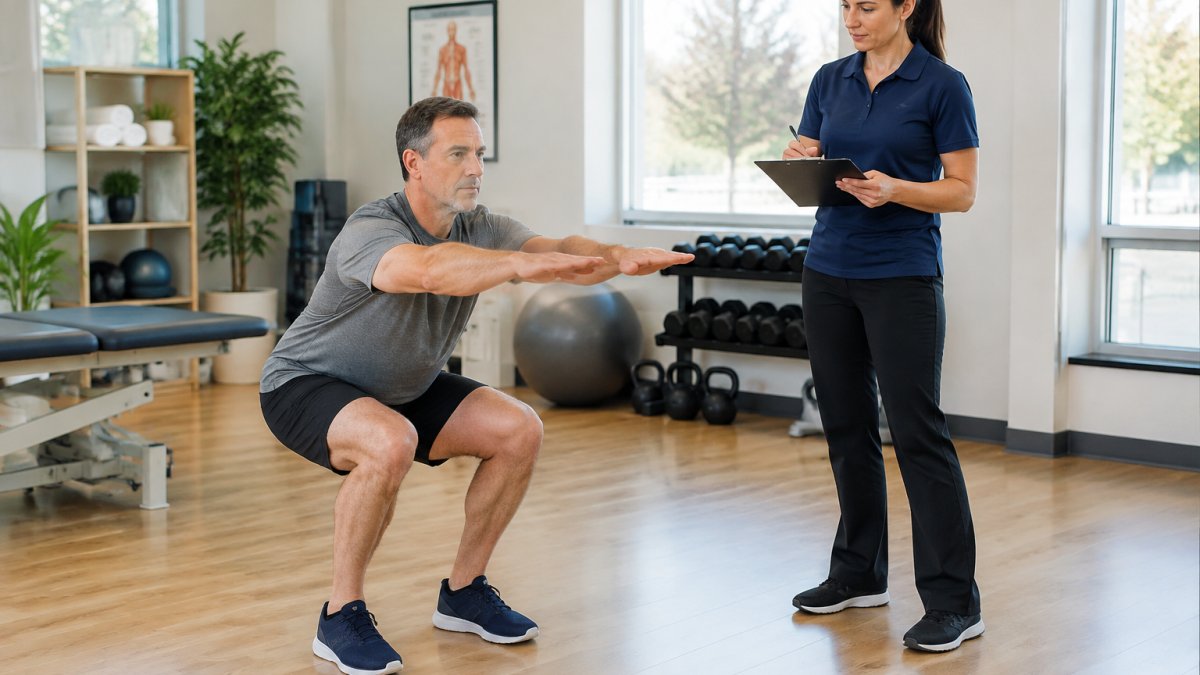
Perform each test barefoot or in flat shoes, and film yourself from the side and front if possible.
- Overhead squat (5 reps): Stand with feet shoulder-width, arms overhead. Squat as deep as you can with a flat back. Watch for: heels lifting, knees caving in, arms falling forward, or lower back rounding.
- Hip hinge (5 reps): Place a dowel or broomstick along your spine (touching head, upper back, and tailbone). Push hips back, keeping the dowel in contact. Watch for: the dowel losing contact at the lower back (rounding) or excessive knee bend.
- Single-leg balance (20 seconds each side): Stand on one foot, arms out. Watch for: excessive wobble, hopping, or the raised hip dropping.
How to Interpret Your Results
Score each test as pass (smooth, controlled, no compensations) or fail (any of the watch-for signs). Then use this logic:
- Fail overhead squat + fail single-leg balance: Prioritize ankle mobility and glute strength. Start with heel-elevated squats and banded side steps.
- Fail hip hinge + pass overhead squat: Focus on hip hinge patterning. Practice wall hinges and kettlebell deadlifts with light load.
- Fail single-leg balance only: Add single-leg stance work and hip stability drills (e.g., standing hip abduction).
- Pass all three: You have a solid base. Progress to loaded patterns in Step 3.
Write down your scores and retest every four weeks. A common pattern is that the weakest test improves first when you target it directly.
The man is American.
For a deeper look at how clinicians use a formal screen, see what the Selective Functional Movement Assessment involves.
Step 2: Build Corrective Exercises for Movement Limitations
Corrective exercises target the specific pattern that failed your self-check, not the whole body at once. A 2024 study found that corrective training done two sessions per week for six weeks improved movement quality (PMC functional correction training study). That is a modest schedule most busy professionals can keep.
But the missing piece in most guides is the why: corrective exercise works by retraining the brain-body connection. When a pattern is faulty, your nervous system has learned a compensatory strategy. Simply stretching a tight muscle does not rewire that strategy; you need repeated, perfect practice of the correct pattern to build a new motor program. That is why smooth, pain-free reps matter more than load or duration.
Match the Fix to the Problem
Use your self-assessment results to choose your starting corrective:
- Heels lift in the squat: work ankle mobility with calf stretches and heel-elevated squats. If that fails after two weeks, add ankle dorsiflexion drills with a band.
- Knees cave in: strengthen glutes with banded side steps and clamshells. Progress to single-leg bridges.
- Back rounds in the hinge: practice hip hinge drills against a wall, then progress to dowel hinges. If rounding persists, regress to a seated hip hinge.
- One side wobbles: add single-leg balance work, starting with eyes open and progressing to eyes closed.
Progression and Regression Pathways
Every exercise has an easier version and a harder one. Start where you can move well, then add difficulty only when the current level feels smooth. The table below gives you a clear path for each pattern.
| Level | Squat | Hinge | Push | Pull | Carry |
|---|---|---|---|---|---|
| Regression | Sit-to-stand from a chair | Hip hinge with a dowel at the back | Wall push-up | Band pull-apart | Farmer carry with light weight |
| Baseline | Bodyweight squat | Kettlebell deadlift | Incline push-up | Seated cable row | Farmer carry with moderate weight |
| Progression | Goblet squat | Single-leg deadlift | Full push-up | Pull-up or inverted row | Suitcase carry |
Move up one level only after two weeks of clean, pain-free reps. If pain returns, drop back a level. A common pattern is to rush the progression; watch out: adding load before the pattern is smooth under bodyweight is the fastest way to reinforce the compensation you are trying to fix.
If stiffness and weakness keep coming back, mobility and movement restoration can rebuild the pattern with guided care.
Grab a Free Discovery Call Today →
Step 3: Train the Squat, Hinge, Push, Pull, and Carry
Now put the patterns under real load. Full-body resistance training two to three days per week is enough to improve movement quality, according to Pliability's guidance on movement patterns. Keep it simple:
- Squat: goblet squats, 3 sets of 8
- Hinge: kettlebell deadlifts, 3 sets of 8
- Push: push-ups or overhead press, 3 sets of 8
- Pull: rows or band pull-aparts, 3 sets of 10
- Carry: farmer carries, 3 rounds of 30 seconds
Train in all three planes of motion: forward and back (sagittal), side to side (frontal), and rotating (transverse). Most gym routines ignore the last two, and that is exactly where desk workers lose ground.
Improving Mobility for Desk Workers Without Losing Strength
Sitting all day shortens hip flexors and stiffens the upper back, which quietly wrecks your squat and overhead reach. The fix is not more stretching alone; it is mobility plus strength.
Build this into your workday:
- Stand and do 10 slow squats every hour
- Do a 30-second hip flexor stretch each side after meetings
- Add band pull-aparts between tasks to open the chest
- Keep your strength sessions; do not trade them for stretching only
For a focused plan, read our guide on how to fix rounded shoulders from desk work. Desk workers who pair mobility drills with resistance training keep their strength while they regain range of motion.
How Functional Movement Patterns Physical Therapy Finds the Root Cause
Functional movement patterns physical therapy looks past the sore spot to find why the pattern broke down. The Selective Functional Movement Assessment (SFMA) is a systematic screen that separates a mobility problem from a stability or motor control problem. That distinction matters: stretching a joint that is actually unstable makes things worse.
Dr. Elizabeth Kingshott Cary, PT, DPT, Cert. MDT, is certified in the McKenzie Method® and trained in the Selective Functional Movement Assessment (SFMA). You can read more about the SFMA evaluation we offer and how it guides a one-on-one plan.
Common Mistakes That Stall Movement Quality
Three habits slow almost everyone down. Watch for them.
Mistake 1: Chasing sore spots. Foam rolling a tight hamstring for weeks does nothing if the real limit is a stiff ankle. Watch out: treating the symptom instead of the cause keeps you in a loop of temporary relief.
Mistake 2: Adding load too fast. A pattern that wobbles under bodyweight will fail under a barbell. Earn smooth reps first.
Mistake 3: Skipping the pull and rotate patterns. Most routines overdo push and squat and skip the rest. The imbalance shows up later as shoulder and low-back pain.
Book a Discovery Call at Spinal Haven
Improving your movement takes a plan built for your body, not a generic handout. If pain or stiffness keeps pulling you back, we can help you find the cause and rebuild from there. At Spinal Haven, every session is one-on-one with Dr. Cary, and every plan includes the self-management tools to keep you moving on your own. We offer in-person and virtual care, and our approach is built to reduce your reliance on endless appointments, injections, or surgery.
Book a discovery call with Dr. Kingshott Cary and find out whether one-on-one spinal physical therapy is right for you. Get started with Spinal Haven and move through your day with confidence again.
Frequently Asked Questions
What are the 7 functional movement patterns?
The seven patterns are squat, hip hinge, lunge, push, pull, rotate, and carry. Every lift, reach, and step you take at work or in the gym is a combination of these. Training them directly improves functional movement because you practice the same mechanics your daily life demands. A physical therapist can screen each pattern to spot which ones break down first, then build a plan around the weak links rather than adding more weight to exercises you already do well.
How do I know if my functional movement patterns are dysfunctional?
Watch for asymmetry, pain at end range, or a loss of balance during a bodyweight squat, single-leg stance, or overhead reach. Difficulty hinging at the hips without rounding the lower back is another common sign. A clinician using the Selective Functional Movement Assessment (SFMA) can confirm what you are seeing and trace it to a mobility or motor control issue. Early screening can help you address problems sooner.
How can desk work negatively impact functional movement patterns?
Prolonged sitting shortens hip flexors, reduces ankle range of motion, and trains the upper back into a rounded position. Over time the hip hinge and overhead reach degrade, and the body compensates through the lower back. Improving mobility for desk workers means breaking up sitting every 30 to 45 minutes, adding hip flexor and thoracic mobility work, and loading the hinge and pull patterns with resistance training two to three days per week to counter the desk posture.
What is the difference between functional movement and traditional strength training?
Traditional strength training isolates muscles and loads them through a fixed range, like a leg extension machine. Functional movement training teaches the body to coordinate the kinetic chain through squat, hinge, push, pull, rotate, and carry patterns that mirror real tasks. Both build strength, but functional work also sharpens motor control, stability, and postural alignment.