 How-to
What Is Functional Movement Screening for Athletes?
Last Updated: November 5, 2026
Quick Summary
Functional movement screening for athletes is a seven-part assessment that scores how well you squat, hinge, lunge, push, pull, rotate, and carry. Each pattern is scored to reveal where mobility or stability breaks down, and asymmetry between sides matters more than the total score.
- A trained clinician runs all seven screen patterns in a single session.
- A 2 on your left lunge and a 3 on your right tells us more than the total.
- Start corrective work with the pattern you scored lowest on, not the one you enjoy.
- Re-test every four weeks using the same self-check to track progress.
- If a pattern still produces pain after two weeks of regression work, stop and get it assessed.
Table of Contents
- What Functional Movement Screening for Athletes Actually Measures
- The Seven Functional Movement Patterns Behind Every Screen
- How to Perform a Functional Movement Screen: Step by Step
- What Your Functional Movement Screen Results Mean
- Functional Movement Patterns Exercises to Build Better Movement
- How to Improve Functional Movement Patterns for Beginners
- Where Functional Movement Screening Physical Therapy Fits In
- Book a Movement Assessment at Spinal Haven
- Frequently Asked Questions
What Functional Movement Screening for Athletes Actually Measures
Functional movement screening for athletes is a seven-part movement assessment that scores how well you squat, hinge, lunge, push, pull, rotate, and carry.
The screen was built on a simple idea: fundamental movement patterns require a balance of mobility and stability, according to Cook et al.'s foundational FMS paper.
At Spinal Haven, we use movement screens to help identify those workarounds. Here is what the screen measures, how it works, and what your score actually tells you.
The Seven Functional Movement Patterns Behind Every Screen
Seven patterns make up the standard screen. Each one tests a basic movement you use daily, from picking up a bag to climbing stairs.
Squat, Hinge, and Lunge: The Lower-Body Trio
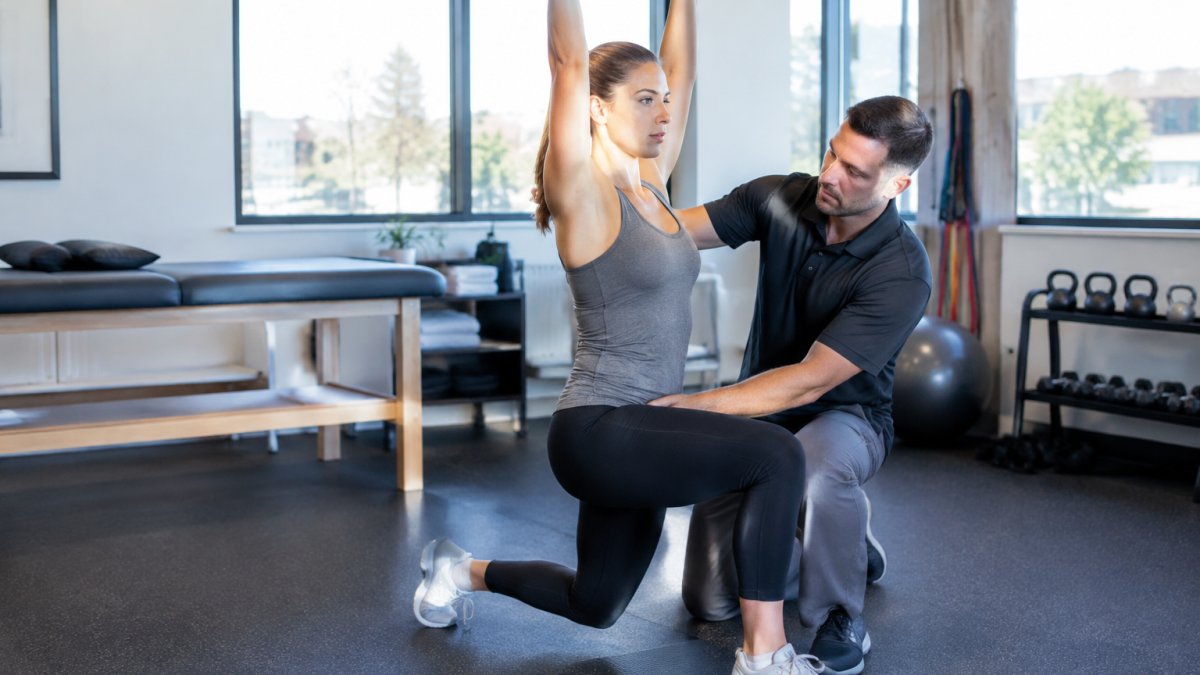
The deep squat tests hips, knees, and ankles together under load. The hurdle step checks single-leg stability and hip control. The in-line lunge measures balance and rotation control while your feet stay split.
Runners tend to score well here. One study of healthy runners found the in-line lunge was their strongest pattern, at 2.17 out of 3 (Agresta et al., 2014).
Push, Pull, Rotate, and Carry: Upper-Body and Core Control
The shoulder mobility test checks how far your arms reach behind your back. Active straight leg raise measures hamstring flexibility and core control. Rotary stability tests trunk control in a quadruped position. The trunk stability push-up shows whether your core holds while your arms work.
How to Perform a Functional Movement Screen: Step by Step
A trained clinician runs the screen in a single session. Here is the sequence:
- Deep squat. Arms overhead, heels down, descend as low as you can.
- Hurdle step. Step over a raised band without touching it.
- In-line lunge. Split stance, back knee lowered to the floor.
- Shoulder mobility. Reach one hand over the shoulder, one under.
- Active straight leg raise. Lie flat, lift one leg without bending the knee.
- Trunk stability push-up. Push up without letting your hips sag.
- Rotary stability. On hands and knees, reach one arm and leg out together.
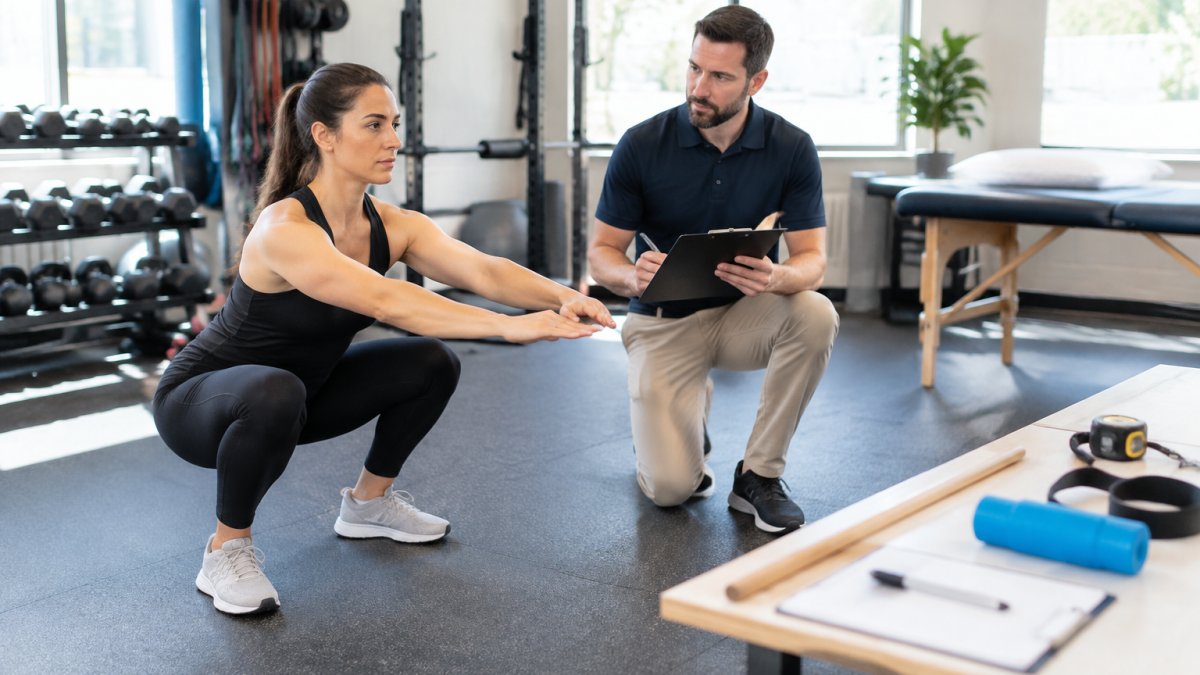
For the full walkthrough with scoring cues, see our 7-step functional movement assessment guide.
Here is the seven-step sequence a trained clinician runs in a single session.
| Step | Pattern | What to do |
|---|---|---|
| 1 | Deep squat | Arms overhead, heels down, descend as low as you can |
| 2 | Hurdle step | Step over a raised band without touching it |
| 3 | In-line lunge | Split stance, back knee lowered to the floor |
| 4 | Shoulder mobility | Reach one hand over the shoulder, one under |
| 5 | Active straight leg raise | Lie flat, lift one leg without bending the knee |
| 6 | Trunk stability push-up | Push up without letting your hips sag |
| 7 | Rotary stability | On hands and knees, reach one arm and leg out together |
What Your Functional Movement Screen Results Mean
Scores vary in most healthy groups, though the range shifts by sport and age.
A low score is not a diagnosis.
What matters most is asymmetry. A 2 on your left lunge and a 3 on your right tells us more than the total.
When a pattern produces pain, the clinical next step is the Selective Functional Movement Assessment. Our SFMA explainer covers how it separates true dysfunction from pain.
Functional Movement Patterns Exercises to Build Better Movement
A corrective exercise is only useful if it matches the pattern you actually failed. Most articles hand you a list and let you guess. The protocol below starts with a simple self-check for each pattern, then gives you the regression to use if you cannot yet perform the standard test, and the progression to load once the pattern is clean.
Deep Squat
Self-check: Stand with feet shoulder-width apart, toes forward, arms overhead. Squat as low as you can with heels down.
Regression: Goblet squat to a box. Sit back to a bench that puts your thighs at parallel, stand, repeat.
Progression: Full-depth goblet squat, then front squat. Add load only when you can hit depth with a vertical torso and heels planted for three sets of eight.
Frequency: 3x weekly, 3 sets of 8.
Hurdle Step
Self-check: Stand on one leg and lift the other knee to hip height without letting your standing hip drop or your torso lean. If your pelvis tilts or you lose balance in under five seconds, single-leg stability is the limiter.
Regression: Single-leg balance reach, stand on one leg, reach the other foot forward, side, and back without touching down.
Progression: Step-up to a box with a slow three-second lower, then single-leg deadlift.
Frequency: Daily, 2 sets each side.
Rotary Stability
Self-check: On hands and knees, reach one arm and the opposite leg out together. If your hips rotate or your low back sags, trunk control is the weak link.
Regression: Bird dog with pause, hold the reach for three seconds before switching.
Progression: Bird dog from a plank position, then half-kneeling chop.
Frequency: 3x weekly, 2 sets of 10.
Grab a Free Discovery Call Today →
Shoulder Mobility
Self-check: Reach one hand over your shoulder and one under, and see how close the fingers come. A gap of more than one hand length on either side signals restriction.
Regression: Wall slides with a band, keep your low back flat and slide your forearms up the wall.
Progression: Overhead carry, then Turkish get-up.
Frequency: Daily, 2 sets of 12.
Active Straight Leg Raise
Self-check: Lie flat, legs straight, and lift one leg without bending the knee. If the opposite leg lifts off the floor or your low back arches, hamstring or core control is limiting.
Regression: Banded hamstring stretch, lie on your back with a band around your foot and pull the leg toward you with a straight knee.
Progression: Single-leg lower from a bridge, then dead bug with a band.
Frequency: Daily, 30 seconds per side.
How to Sequence the Work
Start with the pattern you scored lowest on, not the one you enjoy. Train that pattern first in each session while you are fresh, and keep the others on maintenance. Re-test every four weeks using the same self-check.
Watch out: Adding load before the pattern is clean teaches your body to compensate under resistance, which is harder to unwind than the original limitation.
For progressions specific to each pattern, see our guide to restoring movement patterns.
How to Improve Functional Movement Patterns for Beginners
That distinction matters because the brain, not just the tissue, drives whether a pattern looks clean. A squat that collapses inward is often a motor-control problem, the nervous system has not yet learned to fire the glutes and keep the knee tracking, rather than a strength deficit. Training the pattern with attention, before adding load, gives the brain the repetition it needs to make the clean version automatic.
Start With a Self-Assessment, Not a Workout
Before your first session, run the five self-checks in the corrective exercise section above. Write down which patterns you failed and which side failed. That list becomes your program. A beginner who skips this step usually trains the patterns they are already good at, which widens the gap rather than closing it.
The Regression-First Rule
If you cannot perform a pattern cleanly with bodyweight, you do not need more effort, you need an easier version. The regression pathways above (box squat, single-leg balance reach, bird dog with pause, wall slides, banded hamstring stretch) exist so you can train the pattern at a difficulty your nervous system can control. Spend two to four weeks at the regression before retesting. Most beginners find one or two patterns need this extra time; the rest progress quickly.
Build Frequency Before Intensity
Bodyweight practice daily beats a hard session twice a week for beginners. The goal in the first month is repetition of clean movement, not fatigue. Hold each stretch for 30 seconds, not 5, short holds do not give the tissue time to respond. Film yourself once a week from the front and the side; the camera catches hip shift and heel lift that you will not feel.
Add Load Only When the Pattern Is Clean
Once a pattern looks smooth for three sets of eight with bodyweight, add resistance training twice a week. Keep the load light enough that form does not change on the last rep. If it does, the load is too heavy for that pattern today.
What the Research Does and Does Not Support
Research on exercise interventions and screen scores is still developing, so treat progress as gradual and re-test rather than assuming a score will jump (Maleki et al., 2025). A screen is a snapshot, not a verdict. The beginners who improve fastest are the ones who re-test every four weeks and adjust based on what changed.
Watch out: Chasing a higher screen score by practicing the test itself, rather than the underlying pattern, produces a better number without better movement.
Where Functional Movement Screening Physical Therapy Fits In
A screen is a starting point, not a treatment plan. Physical therapy turns the findings into a program built around your specific limits.
This is where our approach differs from general rehab. Spinal Haven provides one-on-one physical therapy with Dr. Elizabeth Kingshott Cary, PT, DPT, Cert.
If a screen shows pain or a stubborn asymmetry, our SFMA assessment service explains how we trace it to the source.
Book a Movement Assessment at Spinal Haven
You can train hard for years and never learn why your right hip catches on every squat. A screen can help answer that question.
Spinal Haven offers one-on-one care, in person or virtual, built around your movement and your goals.
Schedule your one-on-one evaluation and find out what your movement is telling you.
Frequently Asked Questions
What is functional movement screening for athletes?
Functional movement screening is a seven-part assessment that scores how well you squat, hinge, lunge, push, pull, rotate, and carry. Each pattern is graded on a scale from 0 to 3, and the scores are added into a composite number. The screen is not a diagnostic test. It shows where mobility or stability breaks down under load so a clinician or coach can decide what to train first. Research on the screen describes it as a way to assess fundamental movement quality rather than sport-specific skill.
What do functional movement screen results actually tell you?
A low score on a single pattern points to a specific restriction, such as limited ankle mobility in the deep squat or poor trunk control in rotary stability. Composite scores vary widely by population. Treat the number as a starting point for program design, not a verdict.
How often should an athlete repeat a movement screen?
Most athletes benefit from a screen at the start of a training block, again after four to six weeks of corrective work, and once more before a competitive season. Repeat it sooner if you change sports, return from an injury, or notice a movement that suddenly feels different. The screen is quick, so frequency is limited more by how often you can act on the results than by the test itself. Retesting without changing your training tells you very little.
Can functional movement screening predict sports injuries?
Not on its own. A single screen score is generally not enough to predict injury. Use the screen to find movement limitations and track progress, and pair it with load management, training history, and a clinical exam. If a pattern is painful rather than just low-scoring, stop and have it assessed by a physical therapist before you train through it.
Your next step is simple: get screened, understand the result, and train the pattern that needs work. Spinal Haven pairs movement-based assessment with the McKenzie Method® and SFMA to find the root cause, not just the symptom. Book a discovery call and start moving with confidence again.