 How-to
Is Your Desk Causing Your Neck Pain?
Quick Summary
Poor desk posture can contribute to neck pain, especially when the head sits forward of the shoulders for hours and the neck muscles work harder to hold it up. Posture is a common factor, but neck pain can have many sources, so it should not be blamed automatically.
- Set your monitor top at or slightly below eye level, about 20 to 30 inches from your eyes.
- Keep your feet flat on the floor or a footrest, with knees at roughly a 90-degree angle.
- Stand up and move every 30 to 60 minutes to avoid holding one position for hours.
- Start with chin tucks, neck turns and shoulder rolls, performed daily during the first two weeks.
- If pain lasts, keeps returning or limits daily life, consult a physical therapist.
Table of Contents
- How Poor Posture Strains the Neck
- Desk Posture for Neck Pain: Setting Up Your Workstation
- Forward Head Posture and Long Hours on Screens
- Neck Pain Relief Exercises You Can Start Today
- Neck Pain at the Base of the Skull: Common Patterns
- Posture-Related Pain or Something Else?
- When to See a Physical Therapist for Neck Pain
- Frequently Asked Questions
Is Your Desk Causing Your Neck Pain?
Last Updated: October 30, 2026
How Poor Posture Strains the Neck
Many active adults who spend long hours at a desk wake up with a stiff, sore neck and ask whether the way they sit is causing the pain.
Posture is a common factor. Mayo Clinic lists poor posture, such as leaning over a computer or hunching over a workbench, as a common cause of neck pain. Mayo Clinic, Neck pain symptoms and causes
Still, posture is rarely the whole story. Neck pain can come from many sources, so posture alone should not be blamed automatically.
The main idea: when the head sits forward of the shoulders for hours, the muscles at the back of the neck work harder to hold it up. Over time, that extra load can lead to strain and stiffness.
Desk Posture for Neck Pain: Setting Up Your Workstation
A workstation that fits your body can reduce strain. The measurements below are general guidance for setting up a desk.
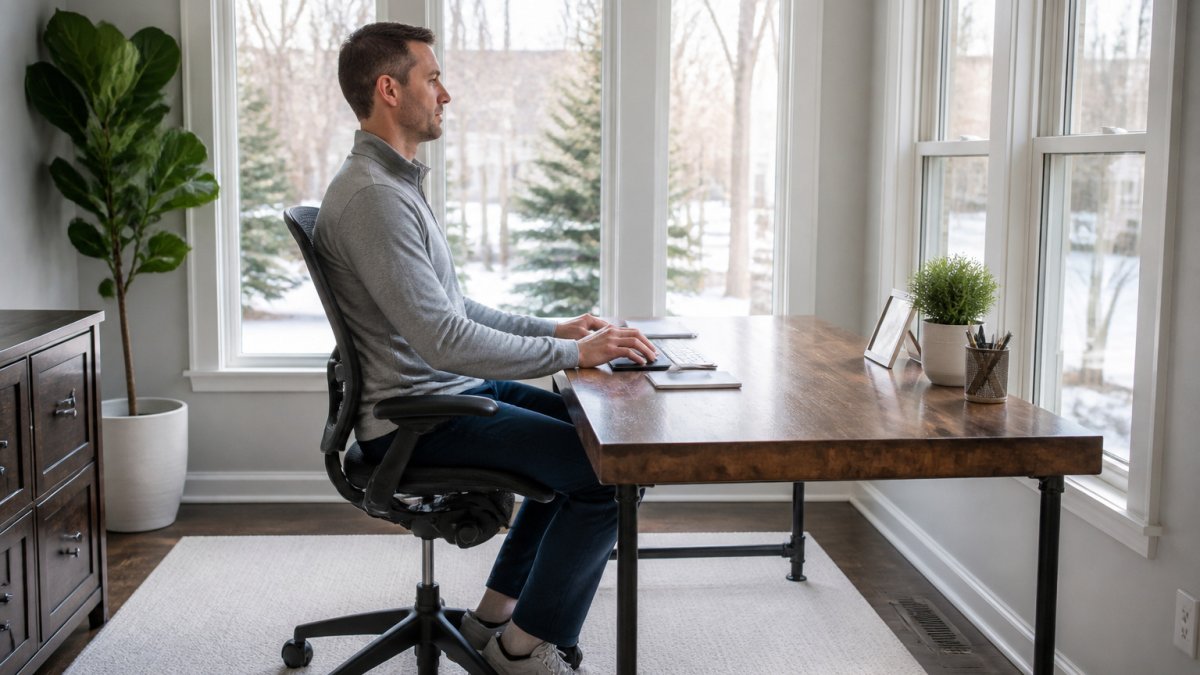
Monitor height and distance
- Position the top of the screen at or slightly below eye level so your gaze rests about 15 to 20 degrees downward.
- Place the monitor about an arm's length away, roughly 20 to 30 inches from your eyes. If you lean forward to read, increase the font size instead of moving closer.
- For laptops, use a stand to raise the screen to eye level and add an external keyboard and mouse. Working on a laptop flat on a desk forces your head down and your shoulders forward.
Chair and keyboard position
- Adjust your chair height so your feet rest flat on the floor or on a footrest. Your knees should be at roughly a 90-degree angle, with your hips slightly higher than your knees.
- Set the backrest to support the curve of your lower back. The seat pan should leave two to three inches between the back of your knees and the edge of the chair.
- Keep your elbows close to your sides and bent at about 90 degrees. Your wrists should stay neutral, not bent up or down, while typing.
- Place the keyboard and mouse close enough that your shoulders stay relaxed and your upper arms hang vertically.
Device-specific adjustments
- Desktop users: Raise the monitor on a stand or books so the top of the screen is at eye level. Keep the screen directly in front of you, not off to the side.
- Laptop users: Use a laptop stand and an external keyboard and mouse. If you frequently work on a laptop without these, limit sessions to 30 minutes and take frequent breaks.
- Tablet and phone users: Hold devices at eye level rather than looking down. Prop your elbows on a desk or cushion to reduce shoulder strain.
- Drivers: Adjust the seat so you can comfortably reach the wheel with your shoulders relaxed. Use a lumbar support and keep the headrest at the center of the back of your head.
Breaks and movement
Even a perfect setup becomes a strain if you hold it for hours. Stand up and move every 30 to 60 minutes. Use a timer or a break reminder app. During breaks, do a few gentle shoulder rolls and chin tucks to reset your posture.
Small changes add up. Move your screen and adjust your chair before you buy new equipment. For a dedicated guide, see how to fix rounded shoulders from desk work.
The article's workstation guidance comes down to a few measurable targets you can set up at your desk.
| Setup item | Recommended value | Note |
|---|---|---|
| Monitor distance | 20 to 30 inches from eyes | Increase font size instead of leaning in |
| Gaze angle | About 15 to 20 degrees downward | Top of screen at or slightly below eye level |
| Knee angle | Roughly 90 degrees | Feet flat on floor or footrest |
| Seat gap | Two to three inches | Between back of knees and chair edge |
| Elbow angle | About 90 degrees | Elbows close to sides while typing |
| Break interval | Every 30 to 60 minutes | Stand up and move during breaks |
Forward Head Posture and Long Hours on Screens
Forward head posture happens when the head drifts ahead of the body. Phones and laptops make it easy to slip into this position without noticing.
A survey of 1,185 office workers found that 42% reported head or neck symptoms over 12 months. SitApp, Posture Statistics 2026 The survey does not prove that posture caused those symptoms, but it shows how common these complaints are among people who sit for work.
Try these habits during the workday:
- Bring your phone up to eye level instead of bending your neck
- Stand up and move every 30 to 60 minutes
- Rest your eyes on something far away for a few seconds
Neck Pain Relief Exercises You Can Start Today
Gentle movement can help many people feel better. Therapeutic exercise has shown improvements in neck range of motion, posture, pain, and disability in a published review. PubMed Central review of posture-correction interventions
Start with these three stages. Move to the next stage only when the current one feels easy and does not increase your pain. For a fuller walkthrough of the method, read our step-by-step McKenzie Method guide for neck pain.
Stage 1: Gentle mobility (Weeks 1-2)
Grab a Free Discovery Call Today →
Do these daily, once or twice a day.
- Chin tucks: Sit tall and slowly draw your chin straight back, as if making a double chin. Hold for 3 to 5 seconds, then relax. Repeat 8 to 10 times.
- Neck turns: Slowly turn your head to look over one shoulder, then the other. Stay within a pain-free range. Repeat 5 times each side.
- Shoulder rolls: Roll your shoulders backward in slow circles 10 times, then forward 10 times.
Stage 2: Strengthening (Weeks 3-4)
Add these exercises two to three times per week, on non-consecutive days.
- Deep neck flexor strengthening: Lie on your back with your chin tucked. Lift your head about an inch off the floor and hold for 5 to 10 seconds. Repeat 5 times.
- Shoulder blade squeezes: Sit or stand tall. Squeeze your shoulder blades together as if holding a pencil between them. Hold for 5 seconds, then relax. Repeat 10 times.
- Wall angels: Stand with your back against a wall, arms bent at 90 degrees. Slowly slide your arms up and down while keeping your back and arms in contact with the wall. Repeat 10 times.
Stage 3: Functional posture (Weeks 5-6 and beyond)
Integrate these into your daily routine.
- Standing chin tucks: Perform chin tucks while standing at your desk. Do 5 repetitions every hour.
- Resistance band rows: Anchor a resistance band at chest height. Pull the band toward your chest, squeezing your shoulder blades. Do 2 sets of 10 repetitions, two to three times per week.
- Prone Y-T-W raises: Lie face down with arms overhead. Lift your arms into a Y shape, then a T shape, then a W shape, holding each for 2 seconds. Do 5 repetitions of each shape.
Progress tracking
Keep a simple log of your pain level (0-10) before and after each session. If pain increases by more than 2 points or lasts more than an hour after exercise, scale back to the previous stage. Progress should feel gradual, aim for small, consistent improvements rather than pushing through pain.
Stop any movement that sharpens pain or causes new symptoms such as numbness, tingling, or weakness. If symptoms persist or worsen, consult a healthcare professional.
Neck Pain at the Base of the Skull: Common Patterns
Some people feel the pain low on the back of the head, at the base of the skull. This often comes with tightness in the upper neck and shoulders.
Tension in these muscles can also contribute to headaches. Because several structures meet in this area, the cause is not always obvious from the location of the pain alone. Tracking when the pain starts, such as after a long workday or a poor night's sleep, can help you and your provider spot patterns.
Posture-Related Pain or Something Else?
Posture-related pain usually builds with long sitting and eases with movement. It often feels stiff or achy and changes with your position.
Other causes need a different approach. Pain that spreads into the arm, numbness, weakness, or pain after an injury should be checked by a professional. The Selective Functional Movement Assessment (SFMA) is a movement-based approach that looks for the root cause of pain rather than only where it hurts. You can read more about the SFMA assessment.
When to See a Physical Therapist for Neck Pain
If neck pain lasts, keeps returning, or limits your daily life, a physical therapist can help. Learn more about neck pain physical therapy. A therapist can assess how your neck and body move, then build a plan around your goals.
Spinal Haven offers one-on-one physical therapy, with both in-person and virtual care options. The focus is on patient education and long-term self-management.
If you are ready to talk about your neck pain, you can book a discovery call to see whether one-on-one therapy fits your situation.
Frequently Asked Questions
Can sitting at a desk all day cause neck pain?
Yes, prolonged sitting with the head held forward can strain the muscles and joints of the neck. Posture alone does not explain every case, so persistent or worsening pain should be evaluated by a qualified clinician. Regular movement breaks and a workstation with the monitor at eye level are practical first steps.
How long does posture-related neck pain take to improve?
Timelines vary with how long the pain has been present, how much activity it limits, and how consistently posture and movement habits change. Many people notice gradual improvement as they adjust their workstation and build a regular exercise routine, but no fixed timeline applies to everyone. If pain is not improving over several weeks, or is getting worse, book an assessment with a licensed physical therapist rather than waiting it out.
When should I seek professional help for neck pain?
Seek prompt medical care if neck pain follows an injury, comes with numbness, tingling or weakness in the arms or hands, or is accompanied by fever, severe headache, or difficulty swallowing or walking. Pain that persists beyond a few weeks, disrupts sleep or work, or does not respond to self-care also warrants a professional evaluation. A physical therapist can help identify what is driving your symptoms and build a plan you can manage yourself over time.
Neck pain from desk work is common, and small changes to your setup and habits can help. If your symptoms persist, a professional evaluation can identify what is driving them. Spinal Haven is ready to help Michigan professionals get back to work and daily life without pain.